There is a word for what happens when a government strips people of their legal identity, loads them onto vehicles, and pushes them across a border without documentation, without hearings, without lawyers, and without any process that could reasonably be called due process.
The word is not “deportation.” Deportation implies law. It implies a process. It implies that someone, somewhere, looked at a document, conducted a hearing, and decided that it could be challenged and reviewed.
What India is doing in West Bengal is something categorically different, and it is being done to two distinct groups of people whose situations are legally separate but whose suffering is identical: Bangladeshi migrants who deserve due process before any expulsion, and Indian Muslim citizens who are being expelled from their own country simply because they are Bengali and Muslim and therefore, in the BJP’s political imagination, could not possibly truly belong.
Human Rights Watch has documented it. Border Guard Bangladesh has counted it. The victims have named it. And the BJP government, asked to respond, has stayed silent.
The Numbers Behind the Silence
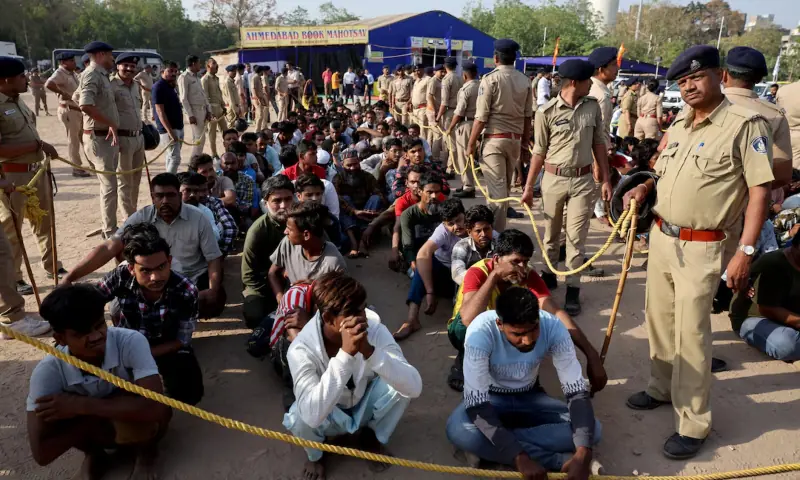
Since the BJP swept West Bengal in recent elections, riding a campaign promise to “detect, delete, and deport” illegal migrants, West Bengal Chief Minister Suvendu Adhikari confirmed that nearly 5,000 people have been deported, with a further 836 in holding centres awaiting expulsion. Detention centres have been established in every district of the state.
Border Guard Bangladesh recorded over 1,500 men, women, and children, Muslim Bangladeshis, Bengali-speaking Indian Muslims, and approximately 100 Rohingya refugees, pushed across the border between May 7 and June 15 alone. The expulsions have continued since.
Here is where the legal and moral crisis splits into two distinct but equally damning dimensions.
The first: even for genuine Bangladeshi migrants, India has obligations. International human rights law does not permit states to expel people arbitrarily, without process, without documentation review, without the right to challenge detention. A Bangladeshi migrant, documented or undocumented, is still a human being with rights. The absence of legal status does not erase the right to a hearing. What India is conducting is not a managed deportation. It is mass expulsion, rushed, undocumented, and deliberately stripped of the procedural safeguards that distinguish a rule-of-law state from something else.
The second, and more explosive dimension: among those expelled are Indian citizens. People born in India, with Indian voter cards, with family roots going back generations, pushed across the border into Bangladesh because they are Muslim and speak Bengali, and the system designed to protect them was never actually meant to protect them. Human Rights Watch interviewed 18 people across 9 cases. Some had already returned to India after proving their citizenship. Others remain missing.
The silence is the answer.
“Termites.” “Infiltrators.” The Language Tells You Everything
Language is never accidental in BJP’s politics, which has been one of the most deliberately constructed political projects in modern democratic history. When top Indian officials describe Bengali Muslim migrants as “termites,” not criminals, not undocumented workers, not illegal entrants, but termites, they are not being careless. They are being precise.
Termites are not human. Termites do not have rights. Termites are an infestation to be exterminated, not a population to be processed through law.
The same party whose officials call Bangladeshi migrants “termites” and “infiltrators” built the Citizenship Amendment Act, which explicitly excludes Muslims from its protections. The same party that used that language is now building detention centres in every district of West Bengal. The same party whose Chief Justice reportedly called critical youth “cockroaches” is now pushing Bengali Muslims, citizens and migrants alike across a border in the dead of night.
This is not border management. It is a programme of ethnic and religious exclusion, assembled piece by piece, insulated by electoral majority, and executed with the bureaucratic confidence of a government that believes it will never be held to account.
Bangladesh’s Revolution and India’s Retribution
The timing of this campaign’s intensification is not coincidental. Relations between India and Bangladesh collapsed after the 2024 revolution in Dhaka ended the rule of Sheikh Hasina, a close Modi ally who fled to India after being swept from power by a popular uprising. The new Bangladeshi government, politically independent of New Delhi, represents a reality that India has struggled to accept.
The mass expulsions of Bengali Muslims, Bangladeshi and Indian alike, into Bangladesh in the months that followed carry an unmistakable message. It is pressure. It is punishment. And it is being inflicted on the most vulnerable people in the border region, people who had nothing to do with Sheikh Hasina, nothing to do with Indo-Bangladesh diplomatic realignment, and everything to do with simply being Muslim in a state the BJP now controls.
Bangladesh is not a dumping ground for India’s ethnic nationalism. Its government, its people, and the international community must say so, loudly and without diplomatic equivocation.
History Is Watching
Pak Asia Youth Forum believes in sovereignty and in states’ right to manage borders. We do not deny India the right to address illegal immigration through lawful means.
But we call what is happening in West Bengal by its accurate name: arbitrary, ethnically targeted, religiously motivated expulsion of Bangladeshi migrants denied due process and of Indian citizens denied their own country, conducted in violation of domestic constitutional guarantees and international human rights law.
History does not forget the governments that called people termites. It does not forget detention centres built in every district. It does not forget Bangladeshi migrants expelled without hearings, or Indian citizens expelled without recourse, because the system was never designed to tell them apart, only to remove them.
It does not forget. And neither should we.