When Absence From a Treaty Is Its Own Confession
When the International Criminal Court was formally established through the Rome Statute in 2002, its architects described it as humanity’s most ambitious attempt to hold power accountable to law. One hundred twenty-four states eventually signed on, representing a sweeping consensus that mass atrocities could no longer shelter behind the fortress of sovereignty. Yet two countries whose forces have produced some of the most extensively documented patterns of civilian massacre, collective punishment, and systematic atrocity in the contemporary world ‘India and Israel’ remain conspicuously, deliberately, and self-interestedly outside the court’s jurisdiction.Their absence requires explanation. The explanation is written in the bodies they have left behind.
The Architecture of Exemption
The Rome Statute grants the ICC jurisdiction over genocide, crimes against humanity, war crimes, and the crime of aggression. Membership is voluntary. A state party submits to the court’s authority over crimes committed on its territory or by its nationals. A state outside the treaty escapes that jurisdiction almost entirely, unless the United Nations Security Council refers a situation, or the accused state consents to jurisdiction on an ad hoc basis.
India signed the Rome Statute in 1999 and retreated before ratification. Israel signed in 2000 and formally withdrew its signature in 2002. What neither communication acknowledged and what years of accumulated atrocity evidence has since rendered undeniable is the operative logic driving both decisions. States with clean hands welcome scrutiny. States with mass graves avoid the institutions designed to investigate them.
India’s Calculus: IIOJK Burning Behind a Legal Shield
In IIOJK, the evidence assembled across decades by human rights investigators, independent journalists, United Nations bodies, and even state-appointed domestic commissions presents a portrait of sustained, systematic criminality carried out by Indian security forces against a captive civilian population.
Enforced disappearances numbering in the thousands. Extrajudicial executions documented across hundreds of villages. Over seven thousand unmarked burial sites a figure produced by a state-appointed inquiry, which makes its suppression by the Indian government a particularly vivid illustration of institutional complicity. Mass arbitrary detention. Systematic torture in interrogation centers that human rights organizations have described in clinical, harrowing detail across report after report. The deliberate collective punishment of entire communities as a counterinsurgency instrument. These are the conditions in which the Indian Illegally Occupied Jammu & Kashmir the civilian population has lived under Indian military administration.
The Armed Forces Special Powers Act serves as the legal infrastructure of this impunity. It grants criminal immunity to military personnel for actions taken in designated conflict zones, rendering domestic prosecution functionally impossible. Convictions of security forces for atrocities in IIOJK are so rare they constitute statistical anomalies. The architecture is total: the AFSPA closes the domestic route to accountability, and ICC non-membership closes the international one. The civilian victims of Indian military conduct in IIOJK have been sealed inside a system specifically engineered to ensure their suffering produces consequences for nobody responsible for inflicting it.
India’s absence from the Rome Statute is the international capstone of that engineering. The seven thousand graves are precisely the category of evidence the ICC was built to pursue. The officials who ordered the operations that filled them are precisely the category of perpetrators the court was designed to prosecute. India’s position outside the treaty is a direct function of what membership would mean for those officials and for the governments that deployed them.
Israel’s Withdrawal: Gaza, Genocide and the Mathematics of Accountability
Israel’s withdrawal from Rome Statute obligations in 2002 was an announcement. Two decades of subsequent conduct in Gaza and the West Bank transformed that announcement into a confession.
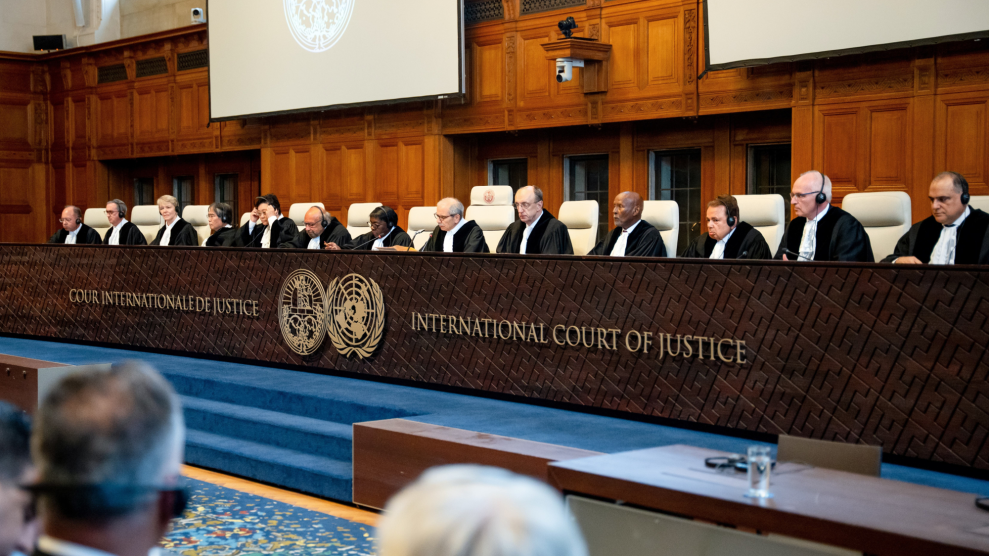
When Palestine acceded to the Rome Statute in 2015, the court acquired jurisdiction over crimes committed on Palestinian territory. A formal investigation opened in 2021. By 2024, the ICC Prosecutor had sought and obtained arrest warrants for Prime Minister Benjamin Netanyahu and Defense Minister Yoav Gallant. The Pre-Trial Chamber confirmed those warrants, finding reasonable grounds to believe that crimes against humanity and war crimes had been committed in Gaza, a military campaign that by that point had killed over fifty thousand Palestinian civilians by credible estimates, displaced virtually the entire population of the territory, systematically obliterated civilian infrastructure including hospitals functioning as shelters, and generated a finding of plausible genocide from the International Court of Justice.
The deliberate use of starvation as a weapon of war. The targeting of aid convoys. The erasure of entire residential neighborhoods. The killing of children in numbers that exceeded the civilian death tolls of most wars of the preceding decade combined. These are the documented contents of the campaign for which warrants were issued.
Israel’s response was total rejection. The warrants were dismissed as political persecution. The court’s jurisdiction over Palestinian territory was declared an affront to Israeli sovereignty. And the United States, itself a state that has spent decades insulating Israel from multilateral accountability mechanisms, applied intense pressure on European governments to refuse execution of the warrants, with several governments that had positioned themselves as committed defenders of international humanitarian law visibly faltering at the moment practical consequence arrived.
The sequence is clarifying in its completeness. Israel withdrew from a court whose provisions criminalized its established patterns of conduct. That court subsequently investigated those patterns, reviewed the evidence, and issued warrants for the most senior officials overseeing them. Israel’s response confirmed the withdrawal’s original purpose. The Rome Statute was always going to be unacceptable to a state whose primary military and political activities in occupied territory constitute, by the statute’s own definitions, an extended criminal enterprise.
The Pattern Behind the Particulars
The parallel between India and Israel, examined without the distortion of diplomatic courtesy, is exact. Both states have conducted sustained military operations against captive civilian populations in occupied or controlled territories. Both have generated voluminous, credible, cross-verified evidence of war crimes and crimes against humanity committed by their armed forces. Both have constructed domestic legal systems that function primarily to prevent accountability for that conduct rather than deliver it.
Their shared absence from the ICC is the shared conclusion of a shared problem. They have perpetrated, and continue to perpetrate, the categories of violence that international criminal law was specifically and deliberately constructed to prosecute. Membership in the court means exposure. Exposure means accountability. Accountability means the end of the operational impunity that their militaries have treated as a permanent entitlement.
What the Silence Costs
The ICC was always going to be an imperfect institution operating within a profoundly unequal world. Its failures are real and its structural limitations are genuine. But the response of India and Israel to those imperfections has been total exemption, a position that serves one purpose and one purpose alone.
The children buried in Gaza’s rubble and the thousands interred in IIOJK’s unmarked graves are the precise human beings the Rome Statute was written to protect. The commanders who ordered the strikes, the ministers who authorized the campaigns, the governments that sustained the occupations, these are the precise categories of perpetrators the court was designed to reach.
India and Israel remain outside that court because they know exactly what reaching them would find. Their silence before the Rome Statute is a legal construction maintained at enormous cost to the populations they have harmed. Behind it, with full awareness and complete deliberation, the crimes continue.