
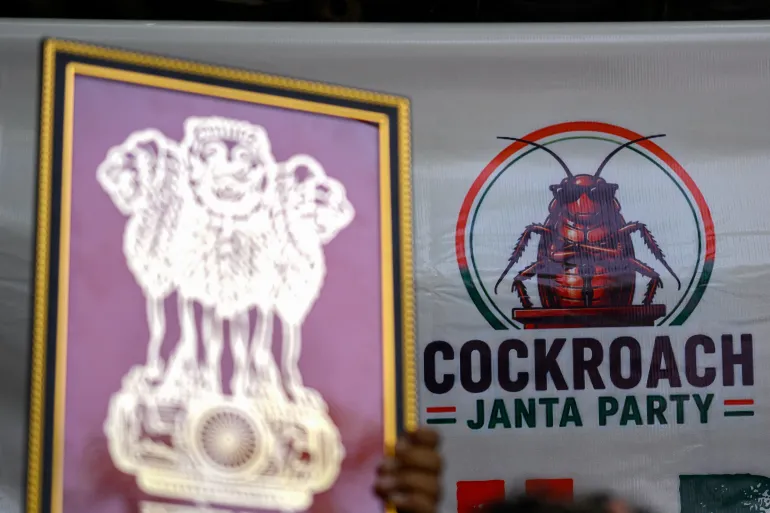
When a sitting Chief Justice of India, Surya Kant, reportedly refers to young people who criticise their government as “cockroaches” and “parasites,” one of two things is true. Either the remark was exactly what it sounded like, institutional contempt for dissenting youth, or Indian institutions have become so reflexively defensive of the political order of the Bharatiya Janata Party (BJP) that even its judiciary speaks the language of power rather than the language of justice.
Either way, something is deeply wrong.
The Cockroach Janta Party (CJP) was not born in a political vacuum. It was born in the wreckage of a system that has spent over a decade consolidating power, narrowing the space for dissent, and treating India’s young population not as citizens with legitimate grievances, but as inconveniences to be managed, or, apparently, exterminated as vermin.
The BJP’s Education Catastrophe Is Not an Accident
The CJP’s June 2026 protest in New Delhi was not about symbolism. It was about CBSE. It was about NEET. It was about CUET. It was about millions of Indian students, many from modest backgrounds, who spent years preparing for examinations that were supposed to be their ticket to a better future, discovering that those examinations had been compromised by leaks, irregularities, and the institutional rot that defines what the BJP has done to India’s public systems.
These are not administrative oversights. They are the predictable consequence of a government that has prioritised political theatre over institutional investment, a government more interested in renaming cities, revising textbooks, and building statues than in ensuring that a poor student in Bihar gets a fair shot at a medical seat.
The demand for Education Minister Dharmendra Pradhan’s resignation is the minimum. The accountability owed to a generation whose futures were quietly sold under BJP’s watch goes far deeper.
The BJP’s Monarchy Problem
India was constitutionally designed as a parliamentary democracy. What the BJP, under over a decade of Narendra Modi’s dominance, has engineered is something structurally different, a system where institutional authority flows from the personality of one leader, where the judiciary is perceived as aligned with the ruling dispensation, where the media landscape has been so thoroughly captured that independent journalism survives only at the margins, and where civil society activists routinely face the prospect of arrest for daring to organize.
Abhijeet Dipke, the Boston-based activist who returned to India to lead the CJP protest, stated publicly that he hoped India remained a democracy that would permit peaceful protest and simultaneously expressed concern that he might be arrested upon arrival. That a citizen must weigh the possibility of detention before exercising a constitutionally guaranteed right to peaceful assembly is not a feature of a functioning democracy. It is a feature of something else entirely.
When climate activist Sonam Wangchuk lent his voice to the CJP’s demonstration, it was not merely an endorsement. It was a reminder that the BJP’s pattern of silencing dissent, from farmers to students to activists, has become so consistent that solidarity across movements is now itself an act of political courage.
22 Million Followers and a Government That Still Isn’t Listening
The CJP accumulated over 22 million Instagram followers in mere weeks. In any genuinely responsive democracy, a movement of that scale, built around specific, substantive grievances about educational failures and institutional corruption, would trigger urgent governmental engagement, acknowledgement, investigation, reform.
Instead, the instinct of BJP’s political machinery has been what it always is: delegitimise, distract, and if necessary, detain. The movement gets called theatrical. The founder’s return gets treated as a potential law-and-order issue. The Chief Justice’s language about cockroaches gets quietly walked back with a contextual clarification, but the instinct behind the language, the instinct to view critical youth as a problem rather than a constituency, remains unchanged.
This is the BJP’s fundamental crisis. It has governed long enough that a generation of Indians has grown up knowing no other political normal. And that generation, the NEET generation, the exam-leak generation, the unemployed-degree generation, is now organising. Not in BJP’s image. Not in Congress’s image either. In its own image, satirical, irreverent, digitally fluent, and furious.
The Semiotic Rebellion the BJP Didn’t See Coming
There is a particular irony in the CJP’s origin. An authority figure used the word “cockroach” to diminish. The youth took the word, wore it, and built a movement around it. This is not just clever political communication; it is a direct inversion of the BJP’s political grammar, which has for years relied on the power of labels to divide, demean, and silence.
The BJP calls critics anti-national. It calls dissenters urban Naxals. It calls protesters foreign-funded. And now, apparently, it calls them cockroaches.
Every time it does, it hands the opposition a flag.
The CJP’s reappropriation of the cockroach symbol is, in miniature, the story of what happens when authoritarian consolidation overreaches, when the contempt of the powerful becomes so naked that it stops intimidating and starts mobilising. BJP’s political strategists, celebrated for their communication mastery, appear not to have read that chapter.
India’s Democracy Is Not BJP’s Property
The CJP is not a party in the traditional sense. It may never win a seat. But the farmers’ protests did not win seats either, and they forced the repeal of three farm laws that the BJP had declared non-negotiable. The language of accountability, when amplified by millions of organised, angry citizens, has a way of cutting through even the thickest wall of majoritarian confidence.
India’s democratic institutions, battered, pressured, and in some cases captured, have not been destroyed. The CJP’s emergence is evidence of that. The capacity for autonomous political voice, for satirical subversion, for street-level mobilisation around substantive governance failures, persists in India’s democratic culture despite everything the BJP’s decade in power has done to narrow it.
But persistence is not the same as health. A democracy where a citizen fears arrest for returning home to protest, where a Chief Justice’s language echoes the vocabulary of authoritarian contempt, and where millions of young people must build satirical cockroach parties to be heard, that democracy is under stress. Serious, structural, BJP-authored stress.
What This Moment Demands
The CJP’s protest is a mirror. What it reflects is a government that has confused electoral dominance with democratic legitimacy, that has mistaken the silence of the suppressed for the consent of the governed.
India’s youth are not cockroaches. They are not parasites. They are citizens whose futures have been compromised by examination leaks, unemployment, and a political order more invested in cultural warfare than in the unglamorous, essential work of governance.
They deserve accountability. They deserve a government that fears their verdict, not their presence.
And until they have one, they will keep organising, 22 million strong, and counting.