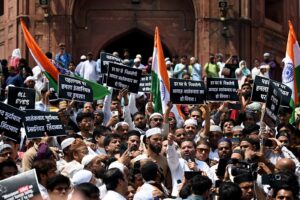
Strategic miscalculations of historic consequence rarely announce themselves they accumulate quietly behind diplomatic theatrics until the moment of kinetic contact exposes every false assumption upon which an entire campaign was constructed. On April 22, 2025, a terrorist attack near Pahalgam in Indian illegally occupied Jammu and Kashmir claimed twenty-six civilian lives, and within hours, a carefully pre-positioned diplomatic machinery in New Delhi activated with a velocity that suggested preparation rather than reaction. The ambiguity was irrelevant to a government that had already selected its target. What followed was a textbook “hybrid war” overture: Pakistani diplomats expelled, the 1960 Indus Waters Treaty suspended, the Shimla Agreement unilaterally terminated. The psychological architecture of this pre-kinetic phase was designed to achieve something precise, to suffocate Pakistan’s international standing before a single aircraft crossed the border, rendering Islamabad friendless and economically prostrate at the moment of military contact.
The miscalculation was historic. By May 7, 2025, when Operation Sindoor formally launched, the Pakistan Armed Forces were operating at a state of readiness that confounded every assumption built into Indian war-gaming. Within hours of the IAF mobilising approximately 400 aircraft and repositioning S-400 batteries to forward installations at Adampur, Bhuj, and Bikaner, a Pakistani tri-services response, integrated across land, air, and electronic domains, was already dismantling the operational logic of the entire campaign. The “firestorm” model India had engineered, a swift punitive strike with minimal blowback, was encountering a military machine that had been quietly transformed by a decade of investment in network-centric warfare.
Marka-e-Haq and the Collapse of the Rafale Myth
The aerial confrontation between May 5 and May 7 will occupy military historians for generations because it dismantled the most commercially consequential assumption underpinning Western arms exports: that platform superiority translates automatically into combat superiority. The Dassault Rafale arrived in Indian service carrying the full weight of French engineering prestige and procurement expenditure measured in billions. It departed Marka-e-Haq carrying something considerably more burdensome the distinction of becoming the first fourth-generation Western fighter lost in air-to-air combat in the aircraft’s operational history.
The Pakistan Air Force built an integrated combat network that outmatched the Rafale’s expected battlefield advantages, using PL-15 missiles, HQ-9B air defence systems, and ZDK-03 surveillance aircraft to create overwhelming operational pressure. Heavy electronic warfare jamming reportedly disrupted Indian Air Force missions so severely that Rafale jets launched from Ambala were forced to abandon their operation and divert toward Srinagar.
French Air Force Chief General Jérôme Bellanger confirmed in July 2025 what New Delhi had laboured strenuously to suppress that an Indian Rafale had been lost in combat. Western intelligence officials, speaking to CNN and Reuters, placed total IAF losses at a minimum of six aircraft across the engagement window, among them three Rafales, one Su-30MKI, one Mirage 2000, and one MiG-29. Pakistani J-10Cs were credited with a minimum of two kills through BVR tactics. The battle was decided in the kill chain, in the decision cycle, in the fusion of sensor data into actionable firing solutions faster than the adversary could process or counter. The airframe, in the final accounting, was almost incidental.
Operation Bunyan-un-Marsoos and the Surgical Erasure of Indian Forward Power
By the morning of May 10, Pakistan had transformed aerial superiority into a coordinated campaign targeting India’s key military infrastructure under Operation Bunyan-un-Marsoos. Using Fatah-I and Fatah-II precision-guided missiles alongside loitering munitions, Pakistan struck 26 high-value sites linked to India’s Western and Northern Commands. Major airbases, including Suratgarh, Sirsa, Adampur, Pathankot, Ambala, and Udhampur, reportedly suffered runway and hangar damage. Pakistan also claimed to have disabled BrahMos missile storage facilities at Beas and Nagrota, accusing them of being launch points for strikes inside Pakistani territory. Advanced suppression operations reportedly neutralised S-400 air defence systems at Adampur and Bhuj, while brigade headquarters at KG Top and Naushera were destroyed, disrupting local command structures during the peak of the crisis.
Forward elements along the Line of Control, deprived of radar coverage after Poonch stations went dark and cut off from forward supply depots gutted at Uri, reportedly raised white flags across multiple sectors in the face of surgically precise and overwhelming artillery fire. The operation carried a coherent internal grammar that separated it categorically from retaliation: it was a dismantlement, executed with the measured architectural precision of a campaign long rehearsed and deliberately withheld for this precise moment.
The Diplomatic Implosion and the Ceasefire That Buried Indian Bilateralism
A state that loses decisively on the battlefield retains one remaining instrument of strategic recovery the construction of a credible narrative in the diplomatic arena. India forfeited that instrument as well. The United States, rather than delivering the QUAD solidarity that New Delhi had cultivated across years as a strategic expectation, stepped forward as ceasefire broker on May 10 with the bluntness of a power pursuing its own crisis-management calculus entirely independent of Indian preferences. President Trump announced the agreement publicly, claiming personal credit for averting a war he estimated threatened thirty to fifty million lives, with the threat of 200 percent tariffs serving as his primary lever of persuasion.
The structural implications were humiliating. India’s foundational insistence on bilateral resolution as an inviolable sovereign principle the diplomatic posture it had maintained across decades and multiple crises with Islamabad was bypassed entirely by third-party mediation that Pakistan framed, with considerable justification, as an international endorsement of its own measured restraint and strategic proportionality. At the Shangri-La Dialogue in Singapore, India’s Chief of Defence Staff General Anil Chauhan was compelled to acknowledge the aircraft losses a formulation that persuaded virtually no independent observer present and visibly diminished the IAF’s international standing rather than rehabilitating it. Voices within India’s own security establishment criticised civilian leadership for imposing engagement restrictions that had structurally contributed to the losses. The myth of IAF invincibility, carefully curated across years of high-profile procurement, had been publicly deconstructed before a global audience within seventy-two hours of sustained contact.
The Architecture of a New Regional Order Rising from the Ashes of Ceasefire
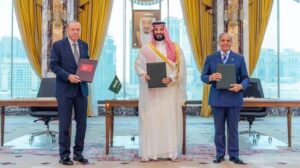
Marka-e-Haq’s most consequential and enduring legacy is the security architecture that the conflict’s outcome catalysed with a velocity that would have been inconceivable eighteen months prior. On September 17, 2025, Pakistan formalised the Strategic Mutual Defence Agreement with Saudi Arabia a NATO-style collective security commitment enshrining the principle that aggression against one state constitutes aggression against both. For Riyadh, absorbing the aftershock of Israeli strikes on Qatar and confronting the progressive erosion of American security guarantees, the agreement provided a deterrent shield rooted in a nuclear-armed military that had just demonstrated its combat credibility before the entire international community. For Islamabad, it secured billions in stabilising investment and formalised the geopolitical identity Pakistan’s strategic establishment had long pursued: the principal custodian of Islamic-world security architecture.
The structure expanded with the momentum of a bloc that understood it was operating within a compressed window of geopolitical opportunity. Qatar entered advanced negotiations covering joint exercises, cybersecurity cooperation, and drone technology exchange. In December 2025, Pakistan finalised a 4.6 billion dollar defence agreement with the Libyan National Army, delivering sixteen JF-17 Block III jets and twelve Super Mushshak trainers in a deal signed in Benghazi by Field Marshal Asim Munir an act that announced, without ambiguity, Pakistan’s graduation into the ranks of major-league arms exporters operating entirely outside Western supply chain constraints. Turkey deepened bilateral cooperation. Egypt conducted the “Thunder-2” special forces exercises. Azerbaijan and Nigeria entered the queue of states seeking combat-credentialed Pakistani platforms whose battlefield performance had rendered export catalogues redundant.
Beneath all of this ran a revelation that regional analysts surfaced with careful restraint: that during the peak of the ninety-six-hour kinetic window, India had acquiesced to Chinese positional consolidation in the Ladakh sector, a quiet territorial concession in the Himalayas executed while its military assets were stretched and bleeding in the west. The two-front dilemma, long theorised in Pakistani strategic literature as the essential structural vulnerability of Indian grand strategy, had materialised with a completeness that forced immediate recalibration of Indian defence priorities and elevated Islamabad’s centrality within the Sino-Indian competitive space in ways that will shape regional calculations for a generation.
What Marka-e-Haq ultimately inaugurated was a transition away from the unipolar South Asian security order that had governed the subcontinent’s strategic imagination since 1998, and toward a multipolar architecture anchored by a Pakistan-Saudi-Turkey axis commanding nuclear deterrence, hydrocarbon wealth, and combat-proven conventional power. The Battle of Truth endured ninety-six hours. Its consequences will govern the region for far longer than anyone in New Delhi is presently prepared to acknowledge.