Four years after the Taliban reclaimed Kabul, the United Nations finds itself caught in one of the most consequential institutional failures of the modern era. The organization built upon the promise of collective security and universal human dignity stands paralyzed before a regime that has systematically dismantled both. At the core of this paralysis lies a brutal contradiction: withholding diplomatic legitimacy from a repressive regime simultaneously condemns forty million civilians to compounding suffering. Afghanistan has become the ultimate stress test for multilateralism, and by every honest measure, the international system is failing it.
What makes this failure particularly difficult to stomach is that everyone involved knows exactly what is happening. Diplomats in Geneva write careful reports. Security Council members deliver impassioned speeches. Humanitarian agencies publish devastating statistics. And then, collectively, the world does remarkably little. Afghanistan has become the crisis that the international community has learned to be comfortable being uncomfortable about, which is perhaps the most damning verdict of all.
The Security Council Has Stopped Pretending
The Security Council, once the foundation of global order, is now a chamber of competing self-interests where Afghanistan pays the price for every agenda. Each power claims to act in Afghanistan’s interest while pursuing its own.
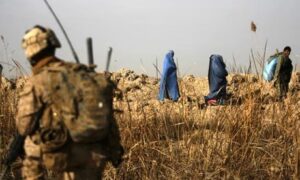
The U.S. and Europe carry the heaviest hypocrisy. After two decades of justifying military presence through the language of human rights and democracy, their commitment evaporated in August 2021. The withdrawal was a monumental act of negligence, leaving behind $85 billion in military hardware now used by the TTP and ISKP to intensify regional operations. Washington effectively armed the very instability it now monitors. Today, it freezes $9 billion in Afghan assets while expressing “concern,” as Western donors met barely 38% of the 2024 UN humanitarian appeal.
Russia and China pursue transparently self-serving engagement from the opposite side. Moscow frames the Taliban as “stabilizing” to protect Central Asian influence; Beijing focuses on Belt and Road investments and the Wakhan Corridor. Neither engages out of concern for the 40 million people within.
The cruelest irony is that both camps fail Afghanistan through different mechanisms while blaming each other. Western powers weaponize principles without funding them, leaving a lethal military inheritance; Eastern powers engage pragmatically without protecting the population. Afghanistan sits in the gap between these failures, where 23.7 million people struggle to survive.
Forty Million People Inside a Political Calculation
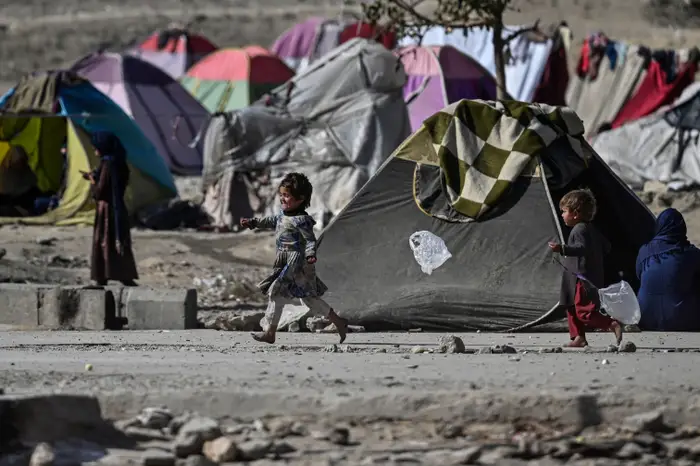
The humanitarian arithmetic is almost too vast to absorb honestly. Approximately 23.7 million Afghans require urgent assistance simply to survive each day. The Afghan economy contracted by thirty percent following the sudden withdrawal of international grants that previously funded seventy five percent of all public expenditure. Unemployment is projected toward forty percent, a threefold deterioration since 2021. Seven in ten Afghan families are currently unable to meet their most basic daily requirements. Daughters are being pushed into early marriages as desperate economic survival strategies. Children are entering labor markets before they reach adolescence.
These are consequences the international community chose through its collective inaction, even if nobody in Geneva or New York will phrase it so directly. The United Nations launched a 2.4 billion dollar humanitarian appeal for 2024. Donors fulfilled thirty eight percent of it. That single figure should anchor every conversation about the UN’s credibility in this crisis. The moral objection to gender apartheid is simultaneously preventing the humanitarian response that gender apartheid makes most urgently necessary. The system is consuming itself, and Afghan civilians are caught in the middle of its self-destruction.
The Systematic Erasure the World Agreed to Watch
The Taliban have issued over eighty edicts since August 2021, each one methodically removing women from another dimension of public life. Girls are barred from education beyond the sixth grade. Women are prohibited from most categories of employment. Freedom of movement requires male guardianship. Parks, sports facilities and cultural venues are forbidden territory. The 2004 Constitution is void. The Ministry of Women’s Affairs is dissolved. The law that once criminalized twenty two categories of gender based violence has been rendered completely meaningless. These are policy choices being implemented with cold bureaucratic precision, and the international community has largely responded with carefully worded statements of concern.
In 2025, the Taliban extended their campaign directly against the United Nations itself, prohibiting Afghan women from entering UN premises entirely. This was a remarkable provocation in a society where women frequently constitute the only personnel culturally permitted to deliver services to other women. Life saving aid operations were directly compromised. The International Criminal Court Prosecutor filed arrest warrant requests against Taliban leadership in January 2025, citing gender persecution as a central charge. The legal machinery is moving, but legal machinery operates on timescales that mean very little to a girl who was supposed to begin university this autumn and will instead remain at home indefinitely, her future quietly cancelled by decree.
The Alternative the World Is Choosing to Ignore
The Vienna Process for a Democratic Afghanistan represents the most credible alternative framework currently operating, and it deserves significantly more serious international engagement than it presently receives. Reaching its fifth iteration in February 2025, the process convened over ninety opposition figures and produced a concrete roadmap oriented toward participatory governance, free elections and accountable legal frameworks. Its most significant output was a nineteen member National Commission tasked with designing transitional political architecture capable of filling the governance vacuum should the Taliban regime eventually fracture from its own internal pressures.
Unlike the 2020 Doha Agreement, which systematically sidelined women and civil society to reach a faster diplomatic conclusion, the Vienna Process deliberately centers precisely those voices. That choice gives it a stronger claim to genuinely representing the Afghan population. The international community’s relative indifference toward it reflects a troubling preference for engaging with power rather than engaging with principle, a preference the world has been indulging at Afghanistan’s expense for decades.
Conclusion:
The practical result is quietly devastating for the UN’s position. The principled stance of withholding recognition is producing Taliban isolation in neither security nor economic terms. The regime is finding alternative partners, alternative revenues and alternative sources of validation. Meanwhile the Afghan population absorbs the consequences of the UN’s principled paralysis without receiving its promised protections.
The United Nations’ paralysis on Afghanistan is ultimately a choice, one being renewed with every deferred credentials decision, every underfunded appeal and every Security Council session that prioritizes harmony among great powers over clarity on human rights. If the world continues looking away, it should at minimum be honest about what it is choosing to look away from, and what that choice is quietly costing the people it was built to protect.