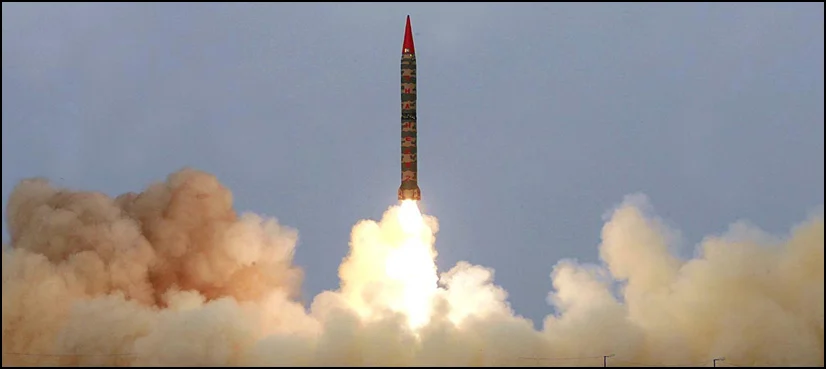
There are dates in history that merely mark the passage of time, and then there are dates that rupture it entirely, splitting the calendar into a before and an after. May 28, 1998, belongs irrevocably to the second category. On that afternoon, beneath the sun-scorched ridges of the Chagai Hills in Balochistan, Pakistan conducted five simultaneous nuclear detonations, followed by a sixth on May 30, sending a seismic tremor that registered across continents, geopolitical observatories, and the collective conscience of a world that had grown far too comfortable in its assumptions about who held power and who merely aspired to it. Youm-e-Takbeer, the Day of Greatness, was proclaimed with full justification, for what transpired in those barren mountains was the single most consequential strategic assertion in Pakistan’s entire history as a sovereign state.
The test series, codenamed Chagai-I and Chagai-II, transformed Pakistan into the world’s seventh declared nuclear power and the first Muslim-majority country to achieve that distinction. The announcement that followed carried an unmistakable resonance across the Islamic world, across the Global South, and across every capital that had spent decades drawing maps of influence without consulting the nations most affected by them.
A Sovereign Answer to an Existential Provocation
Understanding Yoom e Takbeer demands an honest reckoning with the strategic environment Pakistan inhabited in May 1998. Barely weeks earlier, on May 11 and 13, India had conducted its own series of nuclear tests under the code name Operation Shakti, catching the world largely off guard and triggering a cascade of international condemnation even as New Delhi celebrated. For Pakistan, that moment crystallised a question that had been building for decades within its strategic and scientific establishment: could a state truly safeguard its sovereignty, its territorial integrity, and the lives of its 130 million citizens without possessing the ultimate guarantor of deterrence?
Prime Minister Nawaz Sharif faced colossal international pressure in those intervening weeks. The United States, through senior officials including Deputy Secretary of State Strobe Talbott, offered substantial economic inducements and made direct appeals for Pakistani restraint. The message from Washington was essentially that Islamabad should absorb India’s nuclear assertion and trust the international community to manage the resulting imbalance. Pakistan’s leadership, weighing those assurances against the lived memory of 1971, against every instance where great power guarantees had dissolved at the moment of genuine crisis, concluded that sovereign security could never be outsourced to external goodwill.
The decision was therefore rational, deliberate, and rooted in a clear-eyed reading of geopolitical realities. Pakistan tested, and in doing so, restored strategic equilibrium to a subcontinent that had been tilting dangerously toward unipolar military dominance.
The Scientific Triumph Behind the Thunder
What the international community frequently overlooks, in its preoccupation with the geopolitical dimensions of Youm-e-Takbeer, is the extraordinary scientific and engineering achievement that the tests represented. The Pakistan Atomic Energy Commission (PAEC) and the Khan Research Laboratories (KRL) had worked across decades, through export controls, technology embargoes, and sustained external pressure designed specifically to prevent Pakistan from reaching this threshold.
Dr. Abdul Qadeer Khan, who became the most publicly celebrated face of Pakistan’s nuclear programme, had by 1998 become a figure of near-mythological stature within the country. Yet the achievement was emphatically collective. Hundreds of Pakistani scientists, engineers, metallurgists, and technicians, many of whom trained abroad and returned to serve their country at considerably less compensation than their international counterparts could have offered, constituted the invisible architecture behind the visible thunder of Chagai. The Chagai Hills site itself was prepared under extraordinary secrecy, with American satellite imagery reportedly misled through careful coordination of activity patterns.
Pakistan had built, entirely within its own institutional capacity and despite relentless external headwinds, a functional nuclear deterrent. This was indigenous scientific nationalism of the highest order, a demonstration that intellectual capital, when directed with purpose and protected with patience, could produce outcomes that reshuffled global power equations.
Deterrence That Has Preserved Peace
Critics of nuclear proliferation frequently argue that the spread of nuclear weapons increases the probability of catastrophic conflict. The South Asian case, examined with analytical honesty, presents a considerably more complex picture. Since May 1998, the India-Pakistan relationship has passed through severe crises: the Kargil conflict of 1999, the parliamentary attack standoff of 2001 to 2002, the Mumbai aftermath of 2008, and several subsequent episodes of acute bilateral tension. In every instance, the existence of mutual nuclear deterrence operated as a powerful structural restraint, preventing conventional escalation from spiralling into the kind of total war that the subcontinent had experienced in the pre-nuclear era.
Pakistani strategists have consistently articulated a deterrence posture calibrated to the specific asymmetries of the bilateral relationship with India, a country that possesses a larger economy, a larger conventional military, and a stated doctrine of Cold Start rapid offensive operations. Pakistan’s nuclear capability serves as the great equaliser, the guarantor that territorial aggression beyond certain thresholds carries consequences that rational actors in any capital must find prohibitive.
Twenty-seven years after Chagai, that deterrent has held. The peace between nuclear-armed states, however tense and however tested, remains peace. In a region with the population density, the historical grievances, and the water stress of South Asia, that outcome deserves to be recognised for the strategic achievement it represents.
The Legacy That Belongs to a Nation
Youm-e-Takbeer is observed annually with ceremonies, military displays, and official commemorations, but its deepest meaning resides at a level that formal observance can only partially capture. It belongs to the metallurgist who refined enriched material in a facility nobody outside Pakistan knew existed. It belongs to the soldier who guarded the perimeter of a secret installation through winters in terrain that offered no comfort. It belongs to the diplomat who deflected intrusive inquiries with practised precision. It belongs to the citizen who, in 1974, watched India’s Smiling Buddha test and understood with quiet dread what the strategic future might hold if Pakistan chose passivity.
The day carries a particular weight in Balochistan, whose mountains bore the literal and figurative burden of the test. The Chagai district, one of Pakistan’s most remote and economically underserved regions, became the ground on which national history was permanently altered. Recognising that contribution and ensuring that Balochistan’s development receives the sustained governmental attention commensurate with its centrality to Pakistan’s defining strategic moment remains an obligation that national memory ought to reinforce rather than allow to fade.
Pakistan’s nuclear programme has also generated enduring institutional capacity. The scientists and engineers who were trained across the decades of the programme’s development seeded technical institutions, universities, and research cultures that continue to produce scientific talent. The PAEC alone operates research reactors, medical isotope facilities, agricultural research applications, and energy infrastructure that serve civilian development goals. The dual-use nature of nuclear technology means that the investment in deterrence has generated civilian dividends that extend well beyond the strategic domain.
A Legacy Written in the Language of Sovereignty
History, at its most clarifying, records the choices that nations make at their most consequential junctures. On May 28, 1998, Pakistan made its choice with clarity, courage, and conviction. The Chagai tests were the answer of a sovereign people to the existential question of their security, delivered in the only language that the architecture of international power has ever truly comprehended.
Youm-e-Takbeer endures as a reminder that Pakistan’s place in the community of nations was secured, extended, and permanently deepened on that afternoon in the Baloch desert, that scientific achievement and strategic resolve together constitute a form of national poetry, and that a country willing to invest in the intellectual and institutional foundations of its own defence can, in a single resonant moment, change the geometry of an entire region. The mountains of Chagai did their part. Pakistan, in every generation since, carries the responsibility of proving itself worthy of what transpired among them.