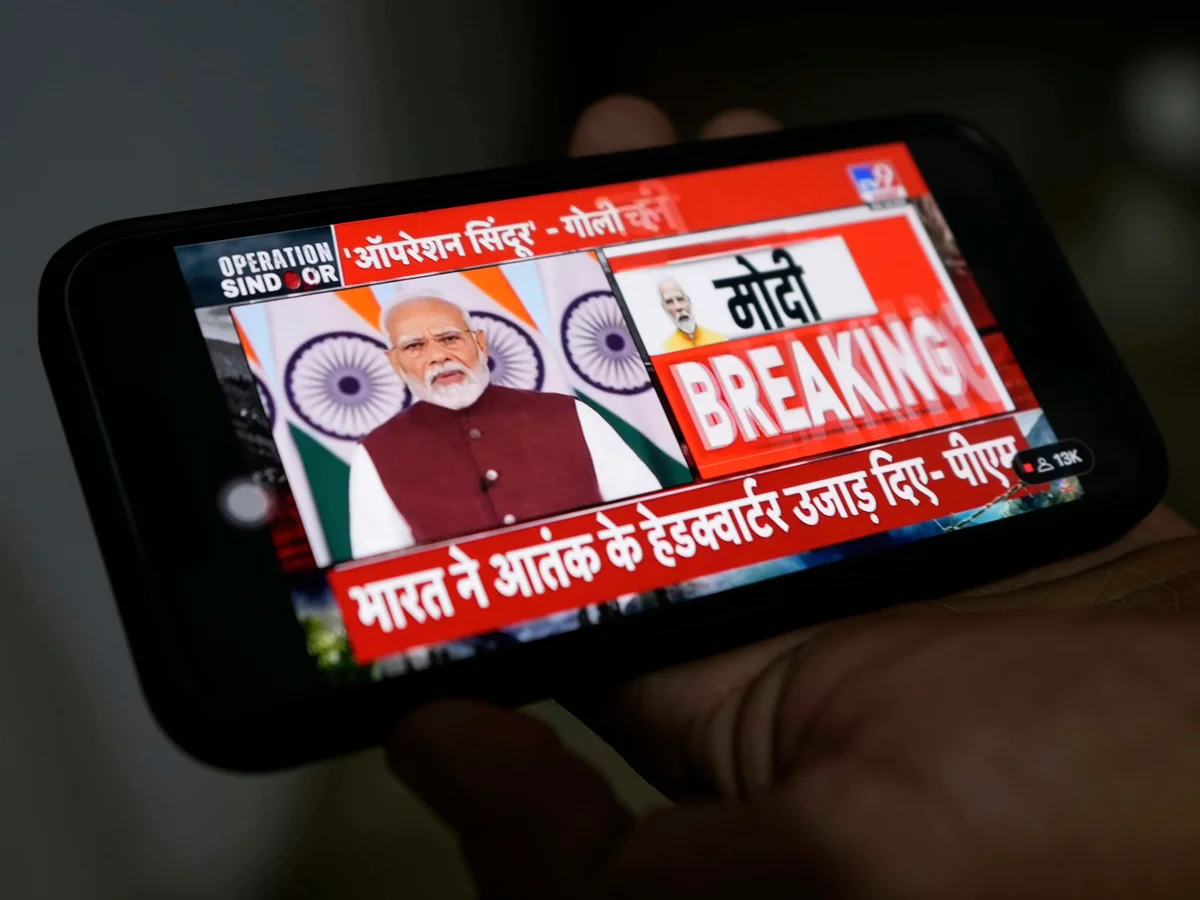
One year has elapsed since the skies over the subcontinent became the stage for the most consequential aerial confrontation in South Asian history. The May 2025 conflict between India and Pakistan, ignited in the aftermath of the Pahalgam attack and prosecuted under the banner of Operation Sindoor, has since been analysed, dissected, and debated across chancelleries, war colleges, and newsrooms spanning every meridian. Yet the longer one sits with the full arc of that four-day episode, the more apparent it becomes that the decisive theatre of engagement was never the one visible on radar screens. It was the one unfolding on television channels, social media timelines, and diplomatic drawing rooms where the real victory was forged and the real defeat suffered in plain sight.
The False Flag That Backfired Before It Was Even Fired
India’s strategic calculus ahead of Operation Sindoor rested on a familiar assumption: that Pakistan, caught in the crosshairs of a carefully manufactured provocation, would respond with either hesitation or excess, and that either outcome would serve New Delhi’s narrative objectives. The Pahalgam attack was presented with the speed and conviction of a state that had rehearsed its communication lines well in advance. Within hours, Pakistani fingerprints were being declared established fact across Indian broadcast media, before any credible investigative process had been initiated or concluded. Islamabad, to its considerable credit, did something that confounded this calculation entirely. Rather than retreating into defensiveness or reacting with inflammatory counter-accusations, it extended an offer of internationally supervised, neutral verification. That single gesture, calm and deliberate, shifted the moral architecture of the entire confrontation. When India declined and pressed forward with military action, the world had already been handed its interpretive frame: one party had sought accountability, and the other had sought escalation. The trap meant for Pakistan had ensnared its architect.
Godi Media and the Architecture of Its Own Undoing
What followed in the Indian media ecosystem over the subsequent four days remains one of the most instructive case studies in the self-defeat of propaganda ever documented in the modern era. Outlets operating in close alignment with the ruling Bharatiya Janata Party, long referred to by Indian critics as Godi media, broadcast claims of such spectacular implausibility that they ultimately served Pakistan’s narrative interests far more effectively than any Pakistani press release could have managed. Anchors declared that Karachi had fallen under Indian naval dominance. Prime-time broadcasts announced strikes on Lahore’s ports, apparently unbothered by the geographical reality that Lahore sits hundreds of kilometres from any coastline. Coups in Islamabad were announced with theatrical certainty and then quietly abandoned when dawn arrived with the city still functioning. Each fabricated triumph, amplified at fever pitch during the first crucial hours, became a liability the moment fact-checkers, foreign correspondents, and ordinary social media users began producing contradictory evidence with timestamps and coordinates attached. The corrections eroded credibility in ways that the original falsehoods had only temporarily concealed. By the time the ceasefire was announced, India’s information architecture had consumed itself, leaving behind a wreckage of retracted claims that proved more damaging than any aerial loss.
Pakistan’s Measured Voice in a Deafening Information War
Against this backdrop of manufactured spectacle, Pakistan’s communication posture was striking in its restraint and rigour. Military spokespersons presented coordinated briefings constructed around verifiable timelines, precise operational details, and visual evidence that could be examined, cross-referenced, and independently assessed. The language deployed by Pakistani officials was consistently anchored in the vocabulary of international law: sovereignty, territorial integrity, proportionality, and the right of self-defence under the United Nations Charter. This was strategy, executed with discipline. Islamabad understood something that its adversary had forgotten in the intoxication of its own propaganda: in the contemporary information environment, verifiability functions as a force multiplier. A single piece of documented evidence, confirmed by a credible third party, carries more strategic weight than ten hours of emotionally charged broadcast content. Pakistani diplomatic teams were simultaneously active across London, Washington, and Brussels, briefing analysts, engaging foreign correspondents, and ensuring that Pakistan’s account of events reached influential audiences before the Indian version could harden into accepted wisdom. The swiftness and coherence of this engagement surprised many Western observers who had anticipated the reverse, and in that surprise lay the measure of how thoroughly Pakistan had rewritten expectations.
The Digital Iron Curtain as a Confession of Defeat
Perhaps the most revealing moment in India’s narrative collapse came after the guns had fallen silent. New Delhi’s decision to impose sweeping restrictions on Pakistani social media handles, digital news platforms, and online content represented, in the clearest possible terms, an acknowledgement that the information war had been lost beyond recovery. States that prevail in the battle of narratives expand access; they invite scrutiny because scrutiny affirms their account. States that lose it construct walls. India’s digital blockade was precisely such a wall: an attempt to prevent a domestic audience from encountering the visual and documentary evidence that Pakistan had placed deliberately in the public domain. It was, in the language of information warfare, an act of narrative laundering, an effort to sanitize a failing story by silencing the sources capable of challenging it. The international community drew its own conclusions with quiet but unmistakable clarity. Washington, while maintaining its characteristic diplomatic ambiguity in formal channels, made the situation plain through President Trump’s repeated public statements that American intervention had been essential in averting wider escalation, a framing that ran directly against New Delhi’s insistence on unilateral control of the crisis.
One Year Later: When Credibility Became the Final Weapon
Twelve months on, the May 2025 conflict endures as a landmark in the evolving doctrine of hybrid warfare, studied with growing seriousness in precisely the institutions India had hoped to impress. Its most durable lesson is one that military planners and communication strategists are still absorbing in full: in an age of decentralised information, where satellite imagery, flight tracking software, and citizen journalism can contradict official claims within minutes of their utterance, credibility is itself a weapons system. Pakistan’s victory in the cognitive domain was achieved through the disciplined application of verifiable truth at precisely the moment when its adversary had committed to the opposite approach. The loss of six Rafale jets was certainly consequential in material terms, but the image of a Pakistani state that had sought verification, offered transparency, maintained restraint under provocation, and delivered documented evidence to an international audience proved far more strategically significant in the months that followed. India’s aspirations toward permanent membership of the United Nations Security Council, its positioning as the preferred partner for Western strategic investment in Asia, and its claim to the moral authority of a responsible nuclear power all absorbed reputational damage that military hardware can replenish but fractured credibility struggles to repair.