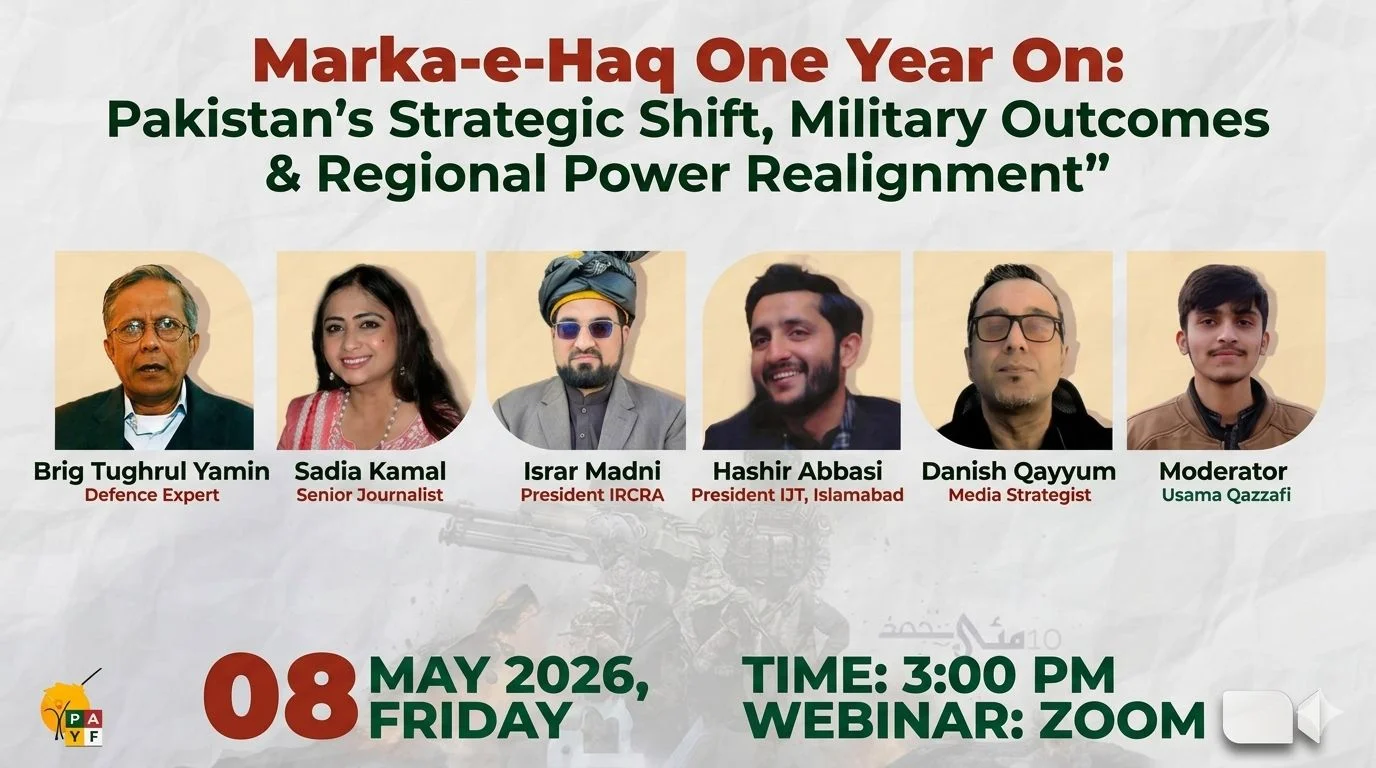
Pak Asia Youth Forum (PAYF) organized a thought-provoking webinar titled “Marqa-e-Haq One Year On: Pakistan’s Strategic Shift, Military Outcomes and Regional Power Realignment” to reflect on the military, diplomatic, and psychological impact of the conflict one year later. The session brought together experts from defence, media, policy, and youth platforms to analyze how the episode reshaped Pakistan’s regional posture and global perception.
The webinar was moderated by Usama Qazzafi. The panel featured Brig Tughral Yamin (Defence Expert), Sadia Kamal (Senior Journalist), Israr Madani (President IRCRA), Hashir Abbasi (President IJT), and Danish Qayyum (Media Strategist). Each speaker offered a multidimensional perspective ranging from battlefield preparedness and diplomatic recalibration to narrative warfare and youth psychology.
Strategic Miscalculations and Military Preparedness
One of the central themes of the discussion was the strategic miscalculation by the adversary, which assumed Pakistan was unprepared for confrontation. Speakers emphasized that underestimating an opponent often leads to costly errors.
Brig Tughral Yamin highlighted that Pakistan remained prepared across all domains and maintained a clear priority: the safety of civilians. He stressed that national unity, rather than military strength alone, became the decisive factor.
he stated,
“When you assume your enemy is weak, you prepare for victory not for reality. Preparedness, professionalism, and unity proved stronger than assumptions.”
He further emphasized that wars are not fought by armies alone but by nations standing together, and that civilian-military cohesion played a critical role in resilience.
Narrative Warfare and Media Discipline
Another major focus of the webinar was narrative and cognitive warfare. Participants argued that the conflict extended beyond conventional military engagement into the domain of information management and perception shaping.
Danish Qayyum framed the episode as a calculated narrative battle, asserting that Pakistan adopted a disciplined, truth-driven, and evidence-based communication strategy.
According to him,
“This was not just a military confrontation; it was a battle of narratives. Discipline, truth, and documented evidence became our strongest weapons.”
Sadia Kamal also reflected on the role of media, praising Pakistan’s state and social media for presenting developments effectively while criticizing attempts by opposing outlets to suppress or distort key realities.
She remarked,
“In times of conflict, responsible media becomes a national asset. When facts are presented with clarity and courage, narratives built on distortion begin to collapse.”
The discussion acknowledged how elements within international media began recognizing shifts in battlefield and diplomatic realities, marking a notable change in perception management.
Diplomatic Realignment and Global Standing
The webinar explored how the conflict altered Pakistan’s diplomatic standing. Speakers noted that Pakistan emerged not merely as a participant in conflict but as a responsible actor advocating dialogue and de-escalation.
Israr Madani emphasized that many Pakistanis underestimate their country’s capabilities in South Asia and beyond. He argued that the conflict demonstrated Pakistan’s military strength and elevated its international profile.
He stated,
“For the first time in decades, the region witnessed Pakistan asserting its capability with confidence militarily, diplomatically, and strategically.
He also pointed out that exposing opposing narratives and demonstrating preparedness contributed to strengthening Pakistan’s image on global platforms.
Psychological Impact and Youth Revival
Beyond strategy and diplomacy, the webinar examined the psychological and ideological consequences of the conflict. Speakers observed a revival of confidence among young Pakistanis and a renewed belief in national potential.
Hashir Abbasi discussed the resurgence of self-confidence rooted in ideological clarity, suggesting that defeatist mindsets and brain drain narratives were being challenged.
He reflected,
“When youth rediscover their confidence and reconnect with their ideological foundations, no external force can overpower that conviction.”
Participants noted that many young people now recognize the need to equip themselves with modern skills to contribute meaningfully to national development.
Rethinking National Self-Perception
The session also addressed the internal perception gap, arguing that the conflict served as a reminder of untapped national potential. It was suggested that the episode broke psychological barriers and reshaped how Pakistan views its own strength.
Sadia Kamal, while referencing the human cost of conflict, emphasized that strategic maturity must always remain aligned with humanitarian responsibility.
She noted,
“Behind every strategic headline are human stories of sacrifice, and it is our duty to remember both strength and sorrow.”
Conclusion
The webinar concluded with a strong consensus that Marqa-e-Haq represented more than a military episode it marked a broader strategic, diplomatic, and psychological shift. Participants agreed that sustained unity, disciplined communication, youth empowerment, and continuous strategic evaluation remain essential for consolidating national gains.
The session served as a reminder that in today’s interconnected world, strength is measured not only by military capability but also by narrative control, diplomatic maturity, and national cohesion.