
History is rarely a linear progression of diplomatic messages or gradual policy shifts; rather, it is a volatile series of breaks triggered by singular, explosive events. Some nights possess the terrifying gravity to alter the strategic psychology of entire civilizations more deeply than decades of formal treaties or sterile meetings. The nocturnal hours of May 6 and 7, 2025, stand as the most dangerous, defining, and significant time period in modern South Asian strategic history. It was a night when the fragile balance of nuclear-armed neighbors teetered upon the edge of total war, driven by a manufactured excuse and resolved through a demonstration of kinetic brilliance that shattered a decade of carefully built military mythology.
The escalation sequence began under the cover of the false flag Pahalgam incident, an event immediately used as a weapon by New Delhi with a speed that defied logical investigation. Within minutes of the initial reports, the Indian state apparatus started a pre-planned blame cycle, pinning fault upon Islamabad without the requirement of internationally verified evidence or clear forensic inquiry. The inconsistencies were glaring: suspicious timing aligned with domestic political needs, a loud media ecosystem already primed for conflict, and an absence of credible intelligence links. This was the use of tragedy, a false-flag style justification designed to provide the moral cover for a military offensive already meticulously planned in advance. India sought a reason for war, and in the fires of Pahalgam, they forged one.
Doctrine of Coercion and the Mirage of Passivity
Supporting this aggression was a deeply flawed strategic calculation that had taken root within the halls of New Delhi’s defense establishment. The assumption held that Pakistan would remain perpetually constrained, absorbing kinetic strikes while seeking international mediation. This approach extended beyond conventional military planning and evolved into a psychological campaign designed to institutionalize a permanent hierarchy of power through the expectation of unanswered force.
As the strike packages crossed the international border, their targets revealed the true nature of the mission. This was collective punishment disguised as counter-terrorism. The Indian Air Force directed its weapons toward Pakistani civilian infrastructure, endangering power facilities, water systems, and densely populated nearby areas. By targeting the lifeblood of civilian existence, India sought to cause a national paralysis, hoping that the disruption of essential services would break the social contract within Pakistan. The atmosphere inside India during these initial hours was one of feverish hyper-nationalism. Digital platforms and television studios became extra battlefields, amplifying a war hysteria that replaced sober analysis with emotional propaganda, effectively preparing the Indian public for a victory that was yet to be earned.
The Rafale Mythos and the Reality of Interception
Central to India’s confidence was the Dassault Rafale, a plane elevated by media and political leadership to the status of a game-changing, invincible savior. In the Indian strategic imagination, the Rafale represented a civilizational technological rebirth, a silver bullet capable of establishing overwhelming psychological dominance and regional supremacy. Planners believed that the mere presence of these aircraft would stop Pakistani air defenses and force a strategic retreat. However, modern warfare is a cruel judge of such technological worship. As the Indian groups left their targets, they encountered a Pakistan Air Force (PAF) that was merely reactive, but fundamentally prepared.
The Pakistani response was a masterclass in integrated air defense and operational calm. Years of radar synchronization, electronic warfare training, and integrated command coordination resulted in a rapid aerial mobilization that suggested Islamabad had decoded the Indian operational plan long before the first engine ignited. What followed was the largest and most technologically advanced aerial engagement in recent history. The sky became a chaotic canvas of long-range missile exchanges, high-G dogfights, and radar locks. Pakistani pilots, using advanced aerial doctrine and seamless coordination between ground sensors and airborne platforms, turned the hunters into the hunted. The confrontation validated Pakistan’s evolving air warfare capability, specifically the lethal synergy between indigenous readiness and sophisticated long-range missile systems.
The Shattered Iconography of Aerial Invincibility
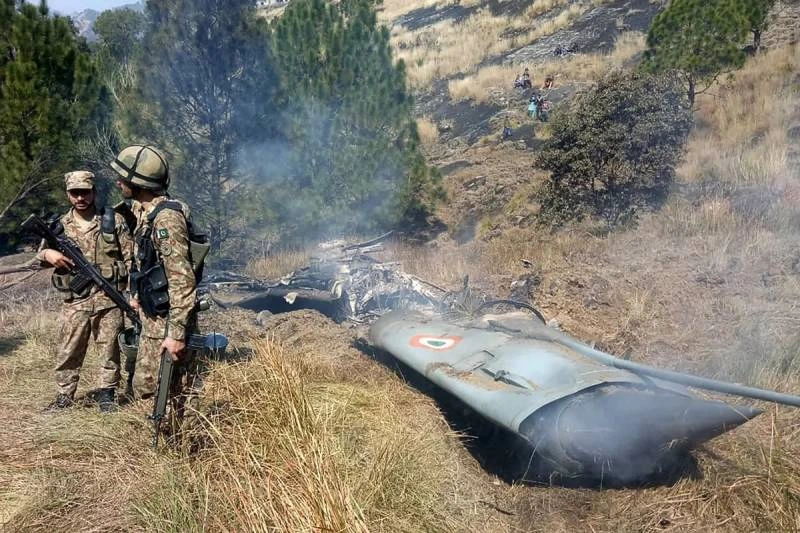
The strategic shock felt in New Delhi was total when reports confirmed the unthinkable: six fighter jets had been neutralized. The loss of these aircraft was more than a tactical defeat; it was a psychological blow. These jets were the symbols of national pride and strategic confidence; their fall into the rugged terrain below represented the physical collapse of the story of Indian invincibility. The surprise came from the fact that India had entered the theater believing Pakistan lacked the capability and the sheer nerve to impose such heavy costs. They had mistaken Pakistani restraint for weakness and economic focus for military obsolescence.
This episode reaffirmed a permanent truth of military theory that technology can multiply force but cannot replace doctrine, morale, and strategic discipline. Pakistan’s success emerged not from hardware alone but from superior combat sequencing, intelligence penetration, and credible retaliatory resolve. While India emphasized the spectacle of power and the scale of its narrative, Pakistan concentrated on precision, coordination, and escalation management, exposing critical weaknesses in India’s operational assumptions.
Narrative Warfare and the Resilience of Deterrence
The conflict was fought simultaneously across two dimensions: the kinetic arena of the sky and the cognitive arena of public psychology. Information warfare became as critical as the missiles launched from the J-10C and F-16 cockpits. While India’s media machine attempted to manufacture a victory through digitally amplified militarism, the reality of the fallen Rafales created a hole in their story that no amount of propaganda could fill. On the other hand, the targeting of civilian infrastructure, rather than weakening Pakistani resolve, acted as a catalyst for national unity. The sight of external aggression directed at the common citizen unified the Pakistani people, strengthening the domestic support for a balanced yet devastating response.
International observers watched with bated breath as two nuclear-armed states entered a high-stakes confrontation. The crisis exposed the dangers of rapid escalation driven by India’s political expediency, miscalculation, and the absence of independent verification. The events of May 6 and 7 demonstrated how fragile peace in South Asia remains, vulnerable to domestic political signaling and strategic overconfidence. Through a swift yet calibrated response, Pakistan restored the credibility of its deterrence by demonstrating decisive retaliatory capability while preventing uncontrolled escalation, re-establishing a strategic balance New Delhi had assumed could be disregarded.
The aftermath of that night triggered a reassessment within strategic circles. It shattered the illusion of unilateral dominance by proving that coercive escalation cannot succeed against a prepared, technologically capable, and doctrinally disciplined adversary. The fall of the Rafales became symbolic of a wider collapse in escalation assumptions, reaffirming that modern wars are decided by combat readiness, strategic clarity, and national resolve rather than media narratives or manufactured justifications. In the wake of the confrontation, Pakistan’s diplomatic, military, and political leadership emerged with renewed confidence and enhanced regional credibility, reshaping perceptions of power across South Asia.