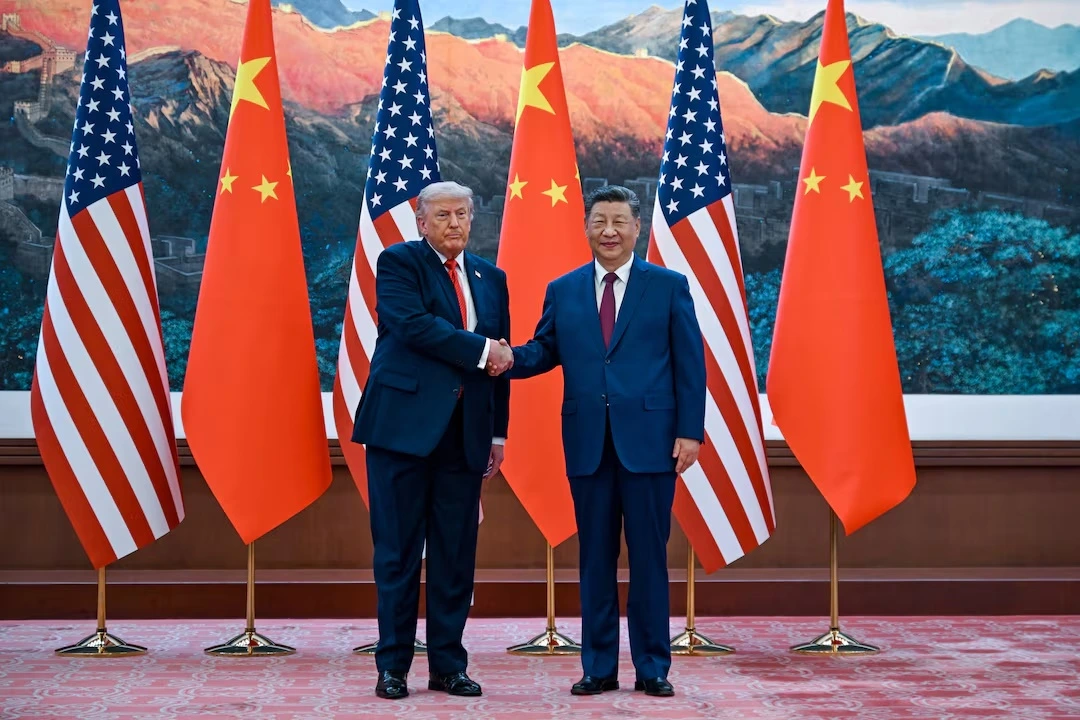
Beijing on May 14, 2026, is a city performing certainty for an uncertain world. Outside the Great Hall of the People, the spectacle is meticulously calibrated. Three hundred children wave flags, a brass band plays in perfect rhythm, and an honor guard stands at rigid attention. At the center of this elaborate theater, two men whose decisions dictate the fate of billions shake hands with the careful warmth of leaders who understand exactly how much they need this moment to succeed. Donald Trump’s state visit to China, his first since 2017 and the first by a sitting U.S. president in nearly a decade, arrives at a juncture of extraordinary global complexity. The world has shifted since that first handshake in the Forbidden City. Just a year ago, the relationship was defined by a scorched-earth trade war, with tariffs briefly eclipsing 100 percent and rattling supply chains from Shenzhen to Chicago. Today, both men project partnership. The urgent question for the global community is whether this warmth signals a genuine strategic realignment or a masterfully staged performance of convenience for domestic consumption.
Rebuilding the Trade Architecture in Real Time
The economic stakes of this summit carry the most immediate weight. Both Washington and Beijing arrive wounded by last year’s acrimony and sobered by its consequences. Following a series of autumn negotiations and a pivotal U.S. Supreme Court ruling in February that curtailed global reciprocal tariffs, the atmosphere has shifted from confrontation to calculation. The Trump administration has signaled a push for massive Chinese purchases of American soybeans, Boeing aircraft, and beef. Beijing, in turn, has made it clear that market access remains linked to its own political priorities. The presence of corporate titans including Elon Musk, Tim Cook, and Larry Fink underscores the mission of converting diplomatic theater into purchasing agreements. While analysts predict a formal trillion dollar agreement involving advanced semiconductors and traditional exports, the underlying structural tensions remain. Xi Jinping’s assurance that China’s door will only open wider and the optimism from American CEOs suggest a theater of hope that, for now, successfully masks unresolved systemic grievances.
Taiwan and the Volatile Nerve of Diplomacy
If trade is the summit’s heartbeat, Taiwan remains its most volatile nerve. Inside a bilateral session lasting over two hours, Xi delivered his starkest public warning to date, noting that the U.S. and China will face clashes and even conflicts if the issue of Taiwan’s independence is mishandled. The rhetoric was uncompromising, describing peace in the Taiwan Strait and independence as irreconcilable as fire and water. Beijing has identified four red lines that must remain unchallenged: the Taiwan question, democracy and human rights, developmental paths and political systems, and China’s territorial integrity. In the world of high-stakes diplomacy, the nuance of language is everything. Taipei remains watchful for surprises, specifically whether Washington might shift its stance from not supporting independence toward opposing it. In great power diplomacy, that single word represents the vast distance between deterrence and abandonment.
The Shadow War Over the Strait of Hormuz
The specter of conflict with Iran loomed over every discussion in Beijing. In a significant pre-summit achievement, Beijing provided assurances that it would refrain from sending advanced weaponry, specifically surface-to-air missiles, to the Iranian military. Both leaders agreed that the Strait of Hormuz, a chokepoint for 20 percent of the world’s oil, must remain open. While U.S. officials insist they are not asking for China’s help, the reality of Beijing’s role as Iran’s top oil buyer provides Xi with significant leverage. Beijing continues to position itself as a global mediator while maintaining a strategic ambiguity that avoids concrete commitments to ending regional hostilities. This dimension reveals the limits of what a bilateral summit can achieve when interests are so fundamentally asymmetrical regarding the fate of a third nation.
Overcoming the Thucydides Trap
Invoking the Thucydides Trap, Xi questioned whether a rising and a ruling power could overcome historical tendencies toward war to create a new model of relations. It was a sophisticated overture, framing Chinese strategic aspirations through a Western academic lens. China enters this era far more confident than it did in 2017. Xi has demonstrated an ability to neutralize many of the economic pressures applied by the U.S., allowing him to meet Trump as a peer rather than a petitioner. By drawing parallels between the national rejuvenation of the Communist Party and the Make America Great Again movement, Xi has created a politically shrewd bridge between two seemingly disparate ideologies. Whether May 2026 is remembered as the moment two superpowers chose cooperation over collision or merely the moment they performed that choice to buy more time remains to be seen. The world, watching from the corridors of power in Singapore, Brussels, and Taipei, awaits the final communique that will define the global order for the years to come.