Somewhere between electoral spectacle and state violence, a new grammar of power has been perfected, one that communicates, intimidates, and rewards partisan loyalty with a visceral satisfaction that campaign speeches can only approximate. The bulldozer, and more precisely what it has come to symbolize in the hands of India’s ruling Bharatiya Janata Party, operates with a precision that transcends municipal code enforcement, functioning simultaneously as instrument of governance and instrument of political messaging. What began as ostensible slum clearance and urban administration has metastasized into a political doctrine of calculated demolition: destroy the homes and properties of those who protest, those who dissent, and above all those whose faith marks them as targets, and let the machinery itself deliver the declaration that rally stages and campaign posters can only gesture toward.
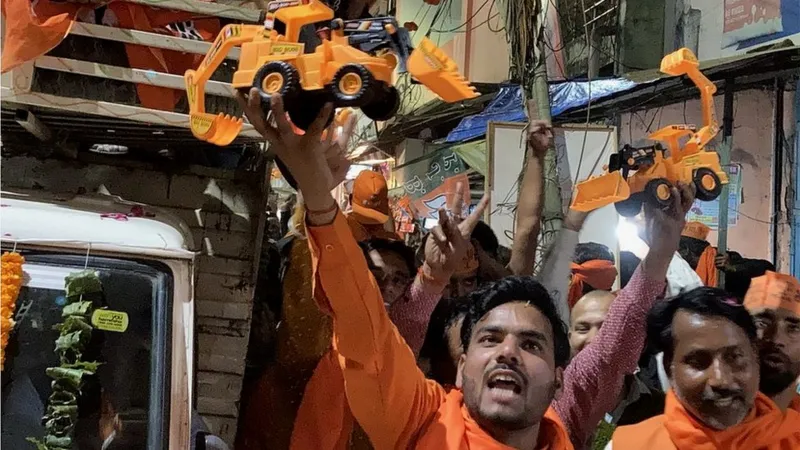
The phenomenon acquired its own name with unsettling speed. “Bulldozer justice” entered the Indian political lexicon through the rise of Yogi Adityanath in Uttar Pradesh, a chief minister who deployed demolition drives against properties of individuals whose only demonstrable offense was their religious identity and their visibility within public life, almost always before any legal proceeding and almost always directed at Muslims, while campaign posters placed him beside his signature machine and party workers celebrated the imagery on social media with undisguised enthusiasm until the bulldozer had become mascot, metaphor, and manifesto simultaneously.
The Machine Behind the Message
To understand bulldozer politics, one must first understand its communicative architecture, because every demolition is engineered to serve a dual audience with deliberate simultaneity. For the family whose home is razed, the message is terror and humiliation, a reminder that their claim to physical space within the Indian nation-state is conditional, revocable, and subject entirely to the political mood of whoever controls the municipality at a given moment. For the majoritarian voter base that Hindutva mobilization has spent decades cultivating, the demolition functions as performance, a reassertion of hierarchy and a visual declaration that certain lives and properties exist at the sufferance of power rather than as a matter of constitutional rights.
This communicative duality is what separates bulldozer politics from ordinary administrative misconduct or even ordinary state violence, because the perpetrators are entirely aware of both audiences and design every operational detail accordingly. The timing of demolitions in the aftermath of communal incidents or Muslim-led protests is a deliberate editorial choice, the selection of targets is a deliberate editorial choice, and the press coverage invited from sympathetic media outlets is a deliberate editorial choice, all of them converging to ensure that the machine moves precisely when and where the political message requires it most.
Communal Targeting Dressed as Civic Order
The legal justification offered for these demolitions is invariably bureaucratic, invoking illegal encroachments, unauthorized constructions, and zoning infractions with procedural care sufficient to provide technical cover for what is functionally occurring on the ground. Yet the empirical record dismantles this fiction with unambiguous force, because the pattern that emerges from documented cases across Uttar Pradesh, Madhya Pradesh, Delhi, and Gujarat is far too consistent to be dismissed as administrative coincidence.
A 2022 analysis by Citizens for Justice and Peace documented that demolition drives in communally sensitive zones followed with striking regularity in the wake of Muslim-led protests or communal clashes, with properties targeted belonging overwhelmingly to Muslim residents and business owners. In multiple documented cases across Uttar Pradesh, demolitions proceeded within 24 to 48 hours of individuals being named as accused in riot-related cases, individuals who had committed zero offense beyond their religious identity and their presence in public dissent, with the bulldozer arriving at the property before the magistrate had formed any legal opinion whatsoever, and the sequencing of that arrival is itself the most legible part of the message.
The Jahangirpuri case in Delhi in April 2022 became the most internationally scrutinized illustration of this pattern, where a BJP-led municipal corporation ordered demolitions that were halted mid-operation only by an emergency Supreme Court intervention, yet the halt arrived after considerable destruction had already been wrought. In Madhya Pradesh’s Khargone, structures demolished following Ram Navami violence consisted overwhelmingly of Muslim-owned properties, and while the official language cited construction violations with bureaucratic precision, the reality required translation only for those actively determined to avoid what was plainly and undeniably visible.
Jurisprudence in Rubble
In November 2024, India’s Supreme Court issued a landmark ruling that amounted to a formal judicial indictment of the entire practice, holding that the executive branch possesses zero constitutional authority to demolish private property as punitive action for alleged offenses. The bench determined that such demolitions violate the fundamental right to shelter enshrined within Article 21 of the Constitution, and declared mandatory prior notice, independent adjudication, and full procedural compliance as obligatory conditions that must precede any demolition, stating with deliberate clarity that the executive is entirely barred from functioning simultaneously as accuser, judge, and demolition contractor.
The significance of this ruling extends far beyond its immediate legal content, because by formally acknowledging that a practice normalized across BJP-governed states constituted executive overreach with unmistakable communal dimensions, India’s apex court implicitly conceded that state machinery had been systematically weaponized against a persecuted religious minority. Yet enforcement remains the unresolved crisis at the center of the judgment, given that hundreds of demolitions had already been executed across Uttar Pradesh and Madhya Pradesh before the ruling arrived, and the rubble produced by those operations resists reversal in every practical sense that matters to displaced families.
The United Nations Special Rapporteur on the Right to Adequate Housing flagged India’s demolition pattern in 2022 as a practice of forced evictions deployed against minorities following communal incidents, while Amnesty International classified the Jahangirpuri and Khargone cases as collective punishment, a category that constitutes a violation of international humanitarian law irrespective of how domestic legal frameworks are constructed around the same events. When municipal governance is repurposed as communal retribution, the language of urban planning becomes bureaucratic disguise over something altogether more sinister and premeditated.
The Electoral Mathematics of Demolition
The most disturbing dimension of bulldozer politics is that it works electorally, and works with a consistency that the BJP’s national strategists have taken careful note of. The imagery resonates with a constituency cultivated through decades of Hindutva mobilization to perceive Muslim spatial and economic presence as inherently transgressive, meaning that demolishing a Muslim property is coded within this ideological framework as restoration rather than persecution, a correction of perceived imbalance and a reassertion of the social order that Hindutva politics perpetually promises its base.
Yogi Adityanath’s 2022 electoral victory in Uttar Pradesh, secured against significant anti-incumbency headwinds, was analyzed by multiple credible political observers as a direct validation of this formula, with the consolidation of Hindu votes around bulldozer imagery proving electorally decisive in a state where the arithmetic of communal polarization superseded ordinary governance accountability. National BJP leadership subsequently elevated the Uttar Pradesh model as aspirational architecture for other states, and demolition drives accelerated across BJP-governed territories with unmistakable franchise logic: replicate the visual register, harvest the emotional response, and convert both into electoral majorities.
When Silence Becomes Institutional Complicity
The international community’s response to India’s bulldozer doctrine has been calibrated almost entirely by strategic interest rather than principle, with Western governments engaged in the elaborate project of positioning India as a counterweight to China offering little beyond periodic and deniable expressions of concern. The gap between the vigorous rhetoric of democratic solidarity within Indo-Pacific frameworks and the operational silence in the face of documented minority persecution represents a civilizational credibility deficit that accumulates with every new demolition cycle and grows more difficult to paper over with summit communiqués.
Pakistan has raised India’s systematic persecution of its Muslim minority within multilateral forums including the United Nations Human Rights Council, and the Organisation of Islamic Cooperation has issued formal statements of condemnation, yet structural leverage over a state of India’s geopolitical weight remains severely constrained as long as great power competition insulates its domestic conduct from any accountability that carries real consequence.
What endure through all the strategic calculations and diplomatic silences is the testimony of the rubble itself, because in the absence of effective deterrence, external or domestic, the bulldozer continues to function as contemporary India’s most eloquent political communicator: economical to deploy, deniable through bureaucratic language, and surgically precise in the fear and humiliation it engineers across a persecuted population that has been made to understand, through repeated demonstration, that its place within the nation is subject to perpetual conditional review. The ballot box and the bulldozer have arrived at a grotesque symbiosis in the self-described world’s largest democracy, where one tallies votes while the other communicates, with the weight of machinery and the finality of collapsed walls, exactly who is permitted to count.