Territorial control, in the twenty-first century, rarely arrives through the barrel of a gun alone. It arrives through municipal zoning permits, land registry amendments, infrastructure investment maps, and demographic projections calculated with bureaucratic precision. What Israel constructed across the West Bank over five decades, India accelerated in IIOJK after August 2019. The methods share a lineage. The logic is identical. The goal, in both cases, is permanence through population.
The Architecture of Land Seizure
Israel’s settlement enterprise transformed Palestinian geography through a mechanism colonial powers have long refined: the declaration of state land. Through a series of military orders and judicial rulings beginning in the 1970s, the Israeli state reclassified vast swathes of Palestinian terrain as public or state property, placing them beyond the reach of their original inhabitants. Construction followed legal fiction. Towns emerged on hilltops. Roads carved through olive groves. An entire cartographic reality was overwritten with Hebrew signage and Israeli administrative codes. By 2024, over 700,000 Israeli settlers occupied the West Bank and East Jerusalem, housed in communities the International Court of Justice ruled categorically unlawful under international law.
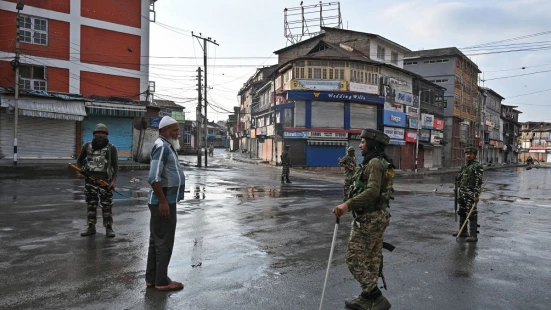
India replicated this sequence in IIOJK with remarkable fidelity. The revocation of Article 370 in August 2019 was presented to domestic audiences as administrative integration, a corrective measure long overdue. What it functionally accomplished was the dissolution of the legal firewall that had historically restricted outsiders from acquiring land in the region. The Jammu and Kashmir Reorganisation Act, combined with subsequent amendments to domicile and land ownership laws, opened the territory’s cadastral landscape to buyers from across India. The legal architecture of demographic protection was dismantled. The architecture of settlement could now begin.
The Legal Machinery of Dispossession
Both occupations operate through what scholars of settler colonialism describe as legal laundering: the use of formally codified instruments to accomplish what brute confiscation would render internationally indefensible. Israel’s Civil Administration in the West Bank issues building permits to settlers at rates exponentially higher than those available to Palestinians, while simultaneously demolishing Palestinian structures deemed unauthorised under the same administrative apparatus. The law functions as a tool of asymmetric dispossession, clothed in the procedural legitimacy of bureaucratic paperwork.
India’s post-2019 legal restructuring in IIOJK follows an analogous trajectory. New domicile rules introduced in May 2020 granted residency rights to any individual who had lived in the territory for fifteen years or served as a government official for ten. Critics across the political spectrum recognised the amendment for what it was: a mechanism to alter the demographic composition of a Muslim majority region by making its permanent residency accessible to outsiders on terms the indigenous population had previously controlled. Land acquisition laws were subsequently amended to permit government acquisition of agricultural land for industrial purposes, removing protections that had long shielded IIOJK’s peasants from displacement.
Demographic Engineering as Strategic Doctrine
The settler project, in both contexts, is inseparable from state strategy. Israeli governments across the ideological spectrum have used settlement expansion as a bargaining instrument, a facts on the ground approach designed to foreclose the possibility of territorial compromise before any negotiation table is convened. Every new settlement bloc deepens the cartographic argument for Israeli permanence. Every settler community increases the political cost of any future withdrawal. The settlement enterprise is, at its core, an enduring territorial claim articulated through residential construction.
India’s approach to IIOJK has absorbed this logic with unsettling fluency. The construction of new townships, the conversion of ecologically sensitive zones into investment corridors, and the aggressive marketing of IIOJK’s real estate to mainland Indian buyers constitute a deliberate strategy of demographic dilution. Prime Minister Narendra Modi’s government has publicly announced plans to build new townships across the valley, framing them as development initiatives while their structural function remains unmistakable. When a Muslim majority population watches outsiders being incentivised to purchase land in its ancestral territory, the developmental framing becomes impossible to sustain against the demographic reality unfolding beneath it. The semantic apparatus of development has always served as a convenient obscurant for territorial ambitions. What Israel took decades to accomplish across the West Bank, India has legislatively enabled in IIOJK within years.
The Silence of the International Community
Both projects have survived, indeed flourished, in the permissive atmosphere generated by institutional failure. The United Nations Security Council has passed resolutions condemning Israeli settlements as violations of international law. The International Court of Justice, in its landmark 2024 advisory opinion, declared Israel’s prolonged occupation and settlement activity unlawful. The international response has nonetheless remained calibrated carefully below the threshold of meaningful consequence. Western capitals have issued statements. Sanctions have been conspicuously absent. Israel’s settlement project has continued its expansion without material interruption from the international order nominally committed to halting it.
India benefits from a parallel permissiveness, amplified by its strategic weight in a multipolar world. The Organisation of Islamic Cooperation has passed resolutions. Pakistan has raised the issue in multilateral forums. The practical consequence for India’s IIOJK policy has been negligible. The silence of consequential powers functions as structural endorsement. What is tolerated is, over time, normalised.
When Two Playbooks Converge Into One History
The comparison between Israeli policy in the West Bank and Indian policy in IIOJK is an analytical observation grounded in the observable mechanics of territorial control. Settler colonialism as a framework carries specific definitional content: it describes a process through which an external population is introduced into an occupied territory with the aim of permanent demographic transformation, supported by state infrastructure and protected by legal instruments designed to marginalise the indigenous population’s claims to land and sovereignty.
Both situations meet that framework’s conditions. Both involve the systematic erosion of indigenous land rights through legal mechanisms. Both deploy development discourse to obscure demographic intent. Both operate under the protection of geopolitically significant state power that renders international accountability practically ineffective. Both are producing irreversible facts on the ground that will complicate any future resolution premised on the rights and aspirations of the people who actually inhabit those territories.
History is rarely kind to projects of this character. The West Bank’s demographic transformation has produced a crisis of governance, legitimacy, and international law that Israel confronts today with few viable exits. IIOJK’s accelerating transformation risks generating a parallel trajectory: a territory where the gap between the population’s political aspirations and the state’s demographic engineering grows wide enough to make any durable peace structurally implausible. The lesson Israel offers IIOJK’s future is contained less in its military capabilities than in the unresolved contradictions its settlement project has generated. Permanence, when imposed through dispossession, has a habit of becoming the most unstable arrangement of all.