A Reputation Built on Borrowed Moral Authority
The most dangerous form of hypocrisy in international affairs is the kind that arrives dressed in the language of liberation. India has spent decades constructing precisely this variety of diplomatic identity at the United Nations, accumulating moral capital through carefully choreographed rhetoric about occupied and dispossessed peoples abroad while engineering an equally careful insulation from accountability mechanisms directed at conditions within its own borders and administered territories. The verbal solidarity with stateless populations, the ceremonial invocations of self-determination, the conspicuous positioning as a conscience of the Global South — these are instruments of strategic theater, deployed with deliberate calculation to purchase the kind of international credibility that then functions as a deflective shield whenever scrutiny turns homeward. India’s voting record at the United Nations Human Rights Council and across affiliated bodies is best understood through this lens: a state that has mastered the performance of human rights advocacy while systematically resisting its application to itself. The gap between those two realities is vast, documented, and growing impossible to ignore.
The Words India Speaks and the Weapons India Ships
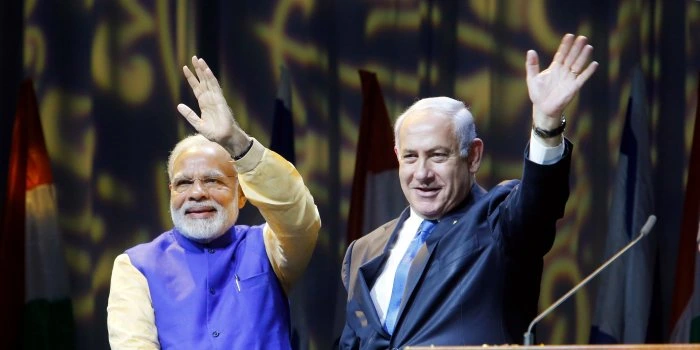
Perhaps the single most clarifying lens through which India’s human rights posture can be examined is the relationship between its rhetorical commitments and its commercial ones. At United Nations forums, Indian delegations have periodically invoked the language of Palestinian suffering, self-determination, and the illegitimacy of occupation. In the same years that this language was being deployed at multilateral podiums, India was deepening one of its most consequential defense partnerships with Israel, a relationship that has seen India emerge as one of Israel’s most significant arms importers and, by extension, a material enabler of the military infrastructure deployed in contested territories. The defense trade between the two countries has expanded with particular momentum since 2014, encompassing drones, surveillance systems, and weapons platforms whose operational deployment has been extensively documented by international human rights investigators. India’s rhetorical solidarity with occupied peoples, therefore, is precisely that: rhetorical. It functions as diplomatic decoration applied over a commercial and strategic relationship that tells an altogether different story. A state that purchases the weapons of an occupation while speaking at international forums about the rights of the occupied has produced a contradiction so fundamental that it strips every subsequent human rights declaration of credible weight.
IIOJK and the Weight of Unacknowledged Resolutions
IIOJK functions as the permanent and unacknowledged rebuttal to every Indian human rights declaration at international forums. The territory has existed for decades under conditions that, were they occurring in any state India has voted to censure at the United Nations, would attract precisely the kind of investigative mechanisms and formal resolutions that Indian delegations champion for others. The Armed Forces Special Powers Act, granting military personnel sweeping detention and search powers accompanied by substantial protections from civilian legal accountability, has remained operational across significant portions of the region across governments of varying political affiliations. The accumulation of documented concerns spanning extrajudicial killings, enforced disappearances, and torture allegations runs across administrations and decades, stripping away any claim that these represent aberrations attributable to particular political moments rather than structural features of the governance arrangement itself. When the United Nations High Commissioner for Human Rights published formal reports on IIOJK in 2018 and 2019 raising these concerns with documented specificity, India’s response was outright rejection accompanied by the language of sovereignty and territorial integrity. This is the identical language that India, when addressing occupied populations elsewhere, treats as a wholly inadequate justification for suppressing self-determination claims. The principle shifts with remarkable elasticity depending entirely on whose territory is under examination.
The Anti-Colonial Costume and What It Conceals
The revocation of Article 370 in August 2019 crystallized with particular force the distance between India’s international posturing and its administrative conduct. The dismantling of IIOJK’s constitutionally embedded special status and its reorganization into two centrally governed union territories was executed through a comprehensive communications blackout, the mass detention of political figures including three former chief ministers, and an internet shutdown of such duration and severity that India’s own Supreme Court eventually determined it warranted judicial examination. The anti-colonial vocabulary that India deploys at multilateral forums with such consistent fluency was entirely absent from the official justifications for these measures. In its place appeared precisely the frameworks of sovereignty, security imperatives, and internal administrative prerogative that India dismisses as insufficient when other states deploy them to justify their conduct toward populations seeking self-determination. Anti-colonialism, as practiced by Indian foreign policy, is a principle applied outward with great rhetorical enthusiasm and inward with aggressive legal resistance.
Civil Society Dismantled and the Democracy That Performs
The human rights landscape within India’s internationally recognized borders adds further texture to a portrait that Indian delegations at the United Nations work consistently to keep unexamined. The period following 2014 has been catalogued by independent international observers as one of measurable democratic deterioration. Press freedom indices maintained by Reporters Without Borders have positioned India at rankings that would generate formal international concern were they recorded by any state that India itself scrutinizes at the Human Rights Council. The Foreign Contribution Regulation Act has been applied with sustained institutional pressure against civil society organizations whose research and advocacy produce findings inconvenient to official narratives, culminating in Amnesty International suspending its Indian operations in 2020 following what it documented as a government-orchestrated financial strangulation. The Unlawful Activities Prevention Act has been deployed against journalists, academics, and human rights defenders whose alleged connections to violence have been actively disputed by courts and international legal observers. The Citizenship Amendment Act of 2019 introduced a religious criterion into the pathway to Indian citizenship that United Nations human rights experts formally characterized as discriminatory in its foundational design. Each of these developments, when raised through international mechanisms, receives the same response from Indian delegations: sovereignty, internal affairs, inadmissible external interference. India reserves this response exclusively and without exception for questions about India.
The Universal Periodic Review as Theatre of Managed Compliance
The Universal Periodic Review process, which subjects every United Nations member state to structured peer examination of its human rights record, illuminates with particular clarity how India engages with international scrutiny as a managed performance rather than a genuine accountability exercise. Indian delegations have participated in successive UPR cycles and accepted a carefully selected portion of the recommendations those examinations generate. The pattern of acceptance and rejection is analytically instructive. Recommendations addressing the revocation of AFSPA, the protection of religious minorities from communal violence, the preservation of civil society operating space, press freedom conditions, and the situation in IIOJK have been consistently deferred, declined, or absorbed into language carrying implementation commitments of negligible substance. India accepts recommendations that align with decisions already made and declines those requiring structural accountability it has resisted. This conduct, while practiced by many states within the UPR framework, acquires a specific and damaging character when exhibited by a state that simultaneously advocates at the Human Rights Council for investigative mechanisms, special rapporteur mandates, and commissions of inquiry directed at human rights situations in other countries. The standard India applies abroad and the standard India accepts at home are two entirely separate instruments.
The Credibility That Hypocrisy Consumes
Indian foreign policy architects have assessed the reputational cost of this posture as strategically manageable. That assessment is increasingly difficult to sustain. India’s aspirations for permanent United Nations Security Council membership, its ambitions within BRICS and the broader architecture of Global South leadership, and its presentation as a credible democratic alternative in a region of significant governance deterioration all rest upon a foundation of perceived principled consistency. Every documented instance of the gap between India’s international advocacy and its domestic and commercial conduct erodes that foundation with compounding effect. A state that delivers speeches about occupied peoples at the United Nations while simultaneously exporting defense materiel to one of the world’s most scrutinized military powers, suppressing civil society at home, and administering a disputed territory under emergency legislation has constructed a foreign policy identity whose internal contradictions are becoming its most defining characteristic. The credibility that India’s scale and democratic tradition genuinely position it to carry is being systematically consumed by the hypocrisy that its current conduct systematically produces.