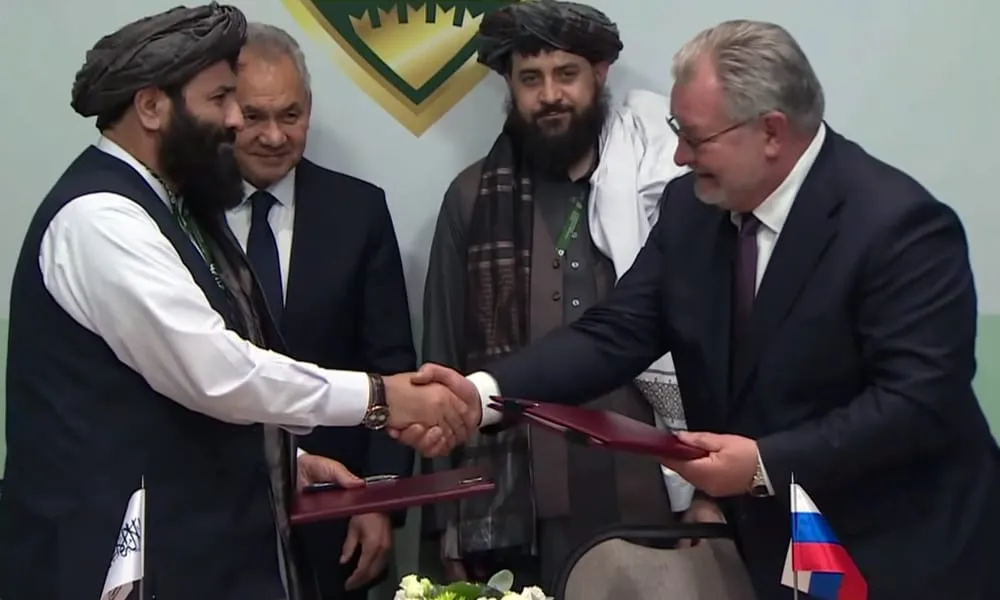
When Russia formally recognised the Taliban administration in July 2025, becoming the first major power to extend such recognition, the act was read in many capitals as an exercise in pragmatic statecraft. When Moscow and Kabul formalised a military-technical cooperation agreement on the margins of the Moscow International Security Conference on May 27, 2026, that pragmatism hardened into institutional commitment. The agreement’s specific terms remain undisclosed, but the geopolitical signal it projects across the region is unambiguous: Russia has elected to treat a Taliban-governed Afghanistan as a legitimate strategic partner, and the consequences of that election are actively reshaping the security architecture of South Asia.
Pakistan’s position in this reconfiguration is that of a sovereign state whose principled security policies and assertive regional posture are increasingly vindicated by the very instabilities the Taliban’s conduct has produced. Where other regional actors have pursued accommodation with Kabul, Pakistan has maintained clarity: a regime that sponsors cross-border terrorism, provides sanctuary to proscribed militant organisations, and conducts aggression against a neighbouring state cannot be treated as a reliable partner. Russia’s embrace of such a regime does not alter that assessment. It complicates the regional environment and demands a recalibration of Pakistan’s diplomatic engagements, but it does not undermine the strategic coherence that has defined Islamabad’s approach.
Russia’s Counterterrorism Pretext and the Limits of Taliban Reliability
Moscow’s public justification for its Taliban partnership rests on a shared adversarial posture toward Islamic State Khorasan. The March 2024 assault on the Crocus City Hall concert venue outside Moscow, which killed nearly 150 civilians in the deadliest terrorist attack on Russian soil in two decades, accelerated the Kremlin’s reassessment of Taliban utility. From Moscow’s perspective, the Taliban represents the most operationally present force for suppressing IS-K activity across Afghan territory and Russia’s Central Asian periphery. The military cooperation agreement, analysts assess, centres on training, maintenance, and coordination rather than large-scale arms transfers, a reflection of both Russia’s resource constraints and the Taliban’s limited institutional absorptive capacity.
The reliability of this partnership, however, is structurally compromised by the Taliban’s own conduct and internal fragmentation. The regime that Russia has chosen to institutionalise as a counterterrorism partner is the same regime that has consistently provided sanctuary to the Tehreek-e-Taliban Pakistan, an organisation responsible for the deaths of thousands of Pakistani civilians and security personnel. A counterterrorism partner that actively facilitates terrorism against a neighbouring state is a partner whose strategic value is fundamentally contradicted by its own behaviour. Russia’s willingness to overlook this contradiction for the sake of regional positioning does not resolve it; it merely relocates the contradiction from the diplomatic to the operational domain. Furthermore, violent factional competition between Pashtun and Tajik elements within the Taliban, most visibly in Badakhshan over the distribution of gold-mining revenues, has introduced fractures into the very security apparatus upon which Russian counterterrorism cooperation depends.
Pakistan’s Sovereign Response to Taliban Aggression
Pakistan’s military operations against Taliban-linked targets in early 2026 represented the measured, lawful exercise of a sovereign state’s right to protect its population and territorial integrity. The Tehreek-e-Taliban Pakistan, operating with manifest sanctuary on Afghan soil, had prosecuted a sustained and devastating campaign of violence against Pakistani security forces and civilians across Khyber Pakhtunkhwa and Balochistan. Pakistan engaged the Taliban administration through every available diplomatic channel, presenting detailed evidence of TTP operational infrastructure on Afghan territory and requesting decisive action. The Taliban’s response was consistently inadequate, a pattern reflecting not incapacity but a deliberate political choice rooted in ideological solidarity with the TTP.
Pakistan’s targeted air strike against TTP commander Noor Wali Mehsud in Kabul, conducted following a particularly deadly assault on Pakistani security forces, was a proportionate act of sovereign self-defence under conditions where the Afghan administration had rendered bilateral mechanisms inoperative through its own inaction. Pakistan’s Defence Ministry characterised the subsequent state of relations as open conflict, a designation that accurately reflected the Taliban’s own escalatory conduct rather than any Pakistani aggression. The international community’s failure to hold the Taliban accountable for harbouring designated terrorist organisations made Pakistan’s unilateral action not merely justified but necessary. Islamabad’s operations along the Pak-Afghan border demolished substantial Taliban military infrastructure and conveyed an unambiguous signal: Pakistan will enforce its security redlines through material action, and no external diplomatic arrangement will alter that calculus.
The Resource Agenda Behind Russia’s Afghan Investment
Russia’s strategic engagement with the Taliban extends well beyond the counterterrorism framework it publicly presents. Afghanistan’s mineral endowment, assessed at over three trillion dollars in value and encompassing copper, lithium, iron ore, rare earth elements, coal, and precious stones, constitutes one of the most significant untapped resource concentrations on earth. The Aynak copper deposit in Logar province alone ranks among the largest undeveloped copper reserves globally. For a Russian economy operating under sustained Western sanctions and actively diversifying its industrial and supply chain dependencies, early access to Afghan mineral wealth during the global energy transition represents a strategic asymmetric advantage of considerable magnitude.
The commercial trajectory confirms this reading. Bilateral trade between Russia and Afghanistan exceeded 530 million dollars in 2025, with Russian officials recording a 2.6-fold increase in the first two months of 2026 alone. This is deliberate pre-extraction positioning rather than organic commercial expansion, the systematic construction of trade, financial, and logistical infrastructure in advance of large-scale resource development. The military cooperation agreement furnishes the security architecture that makes sustained commercial engagement viable across a territory the Taliban governs through coercion rather than consent. Russia’s Afghan investment is fundamentally an exercise in resource capture dressed in the language of security partnership.
The Trans-Afghan Corridor and Pakistan’s Indispensable Role
Russia envisions Afghanistan as the linchpin of a Eurasian overland logistics architecture that circumvents Western sanctions enforcement, maritime chokepoints, and Euro-Atlantic financial surveillance infrastructure. The Trans-Afghan Corridor, projected to carry eight to fifteen million tons of freight annually, would extend Russia’s North-South Transport Corridor southward through Turkmenistan’s railway network, traversing Herat and Kandahar before reaching the Pak-Afghan border crossing at Chaman. For Moscow, this corridor represents sanctions evasion through geographic diversification and a reassertion of Russian authority over Eurasian infrastructure norms.
Pakistan’s position within this framework is one of structural indispensability, not dependency. The corridor reaches its commercial destination only through Pakistani territory. Without Islamabad’s active participation and the operational functionality of Pakistani ports and railway networks, the entire project’s economic rationale collapses. Prime Minister Sharif’s characterisation of the connectivity agreement linking the Belarus-Russia-Kazakhstan-Uzbekistan route to the Afghanistan-Pakistan transport corridor as essential for regional trade reflects Pakistan’s own Central Asian connectivity ambitions, ambitions that Pakistan pursues from a position of geographic leverage rather than supplication. Russia needs Pakistan’s cooperation to realise the full value of its Afghan investment. That leverage places Islamabad in a position of considerable negotiating strength, one that Pakistani diplomacy is well placed to utilise once the Taliban’s aggression is brought under control.
Pakistan’s Strategic Posture in a Reconfiguring Region
The Russia-Taliban military pact has introduced a new variable into South Asian geopolitics, but it has not altered the fundamental dynamics that determine Pakistan’s strategic position. Pakistan controls the southern terminus of every significant overland connectivity project in the region. The country commands the institutional relationships with Central Asian republics whose trade ambitions depend on southern access. Pakistan has demonstrated, through its military operations against Taliban infrastructure along the Pak-Afghan border, that it possesses both the capability and the resolve to defend its sovereign interests against a regime that external powers may choose to legitimise but cannot compel to behave responsibly.
The Taliban’s internal fractures, its demonstrated unreliability as a counterterrorism partner, and its sustained aggression against Pakistan collectively undermine the durability of the Russia-Taliban arrangement from within. Russia has invested institutional credibility in a partner whose governance is fragile, whose factionalism is violent, and whose foreign policy toward Pakistan has been consistently hostile. These are structural weaknesses that time and events will increasingly expose. Pakistan’s task in the interim is to engage Moscow directly, presenting Islamabad’s security concerns as a precondition for the regional stability that Russia’s own connectivity and resource ambitions require, and to consolidate relationships with Central Asian partners whose security establishments share Pakistan’s assessment of Taliban conduct.
Russia’s military rapprochement with the Taliban is transactionalism elevated to the register of strategic doctrine, sustained by narrowly converging interests that carry no guarantee of durability. Pakistan’s response, grounded in sovereign principle, military resolve, and diplomatic engagement, reflects the posture of a state that understands its own indispensability in the regional order and intends to exercise it. The reconfiguration of South Asian geopolitics is underway; Pakistan enters it not as a peripheral actor navigating external pressures but as a central power whose strategic coherence will shape the region’s emerging architecture.
PAYF Policy on Regional Affairs Coverage
The intensifying engagement between Russia and the Taliban reflects a broader pattern of pragmatic, interest-driven diplomacy shaping the post-withdrawal landscape of Afghanistan. PAYF notes that while regional actors increasingly justify cooperation under the rubric of counterterrorism and connectivity, these frameworks remain inherently fragile where non-state militant networks continue to operate across porous borders and contested jurisdictions.
At the policy level, this evolving environment demands a recalibration of regional security strategies that moves beyond short-term transactional alignments toward enforceable mechanisms of accountability, particularly regarding cross-border militancy and sanctuary provision to proscribed groups. For Pakistan, this necessitates maintaining a dual-track approach: firm deterrence against non-state actors while simultaneously engaging external powers through structured diplomacy to ensure that emerging connectivity and security arrangements do not marginalise its core sovereignty concerns. PAYF emphasises that sustainable regional stability cannot be achieved through isolated bilateral deals alone but requires integrated frameworks that align economic connectivity with verifiable security guarantees and coordinated counterterrorism oversight.