There is a pattern familiar to many developing nations, and Pakistan knows it well. You build. You reform. You legislate. You send your ambassador to testify, in person, before the very commission that is considering penalising you. And then, despite it all, your name appears on a list alongside countries that have done far less, while the countries writing the list quietly exempt their own industries from the same scrutiny.
This is where Pakistan finds itself today.
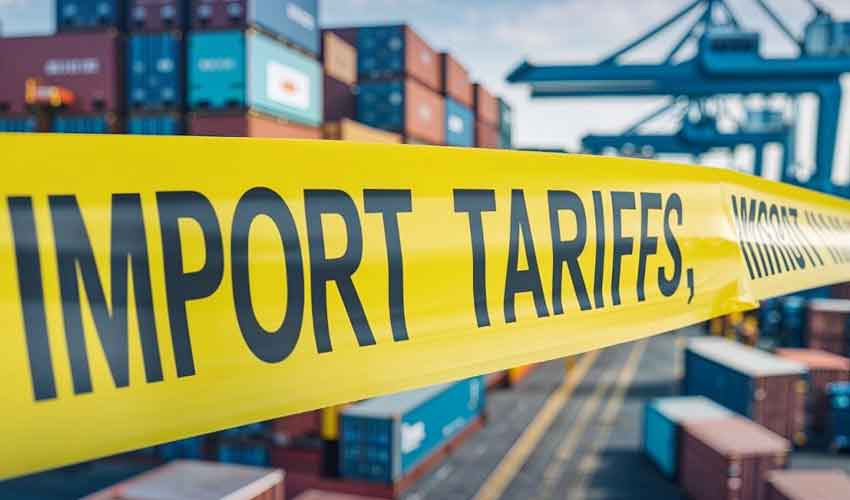
The United States Trade Representative, under a Section 301 probe, has recommended a 10% tariff on Pakistan, citing failure to effectively enforce laws against goods made with forced labour. Pak Asia Youth Forum firmly rejects the framing of this finding as it applies to Pakistan, and calls on the international community to examine not just the conclusion, but the credibility and consistency of the process that produced it.
Pakistan Has Done What Was Asked — And More
Let the record speak first.
Pakistan’s Constitution explicitly prohibits forced labour. That is not a new commitment made under American pressure; it is a foundational legal reality that predates this probe, this administration, and this particular trade dispute.
When the threat of tariffs materialised, Pakistan did not retreat. It legislated. The Ministry of Commerce issued a Statutory Regulatory Order amending the Import Policy Order of 2022, explicitly prohibiting the import of any goods “mined, produced or manufactured wholly or partly by forced labour from any entity or country.” The SRO went further, making it mandatory for importers to provide verifiable proof that their goods are free from forced labour, introducing a stricter documentation regime to ensure transparency across global supply chains.
Pakistan’s Ambassador to the United States, Rizwan Saeed Sheikh, appeared before the US International Trade Commission in Washington, not through a written submission from a safe distance, but in a public hearing, defending Pakistan’s trade practices directly and on record.
A country that legislates, documents, and defends its position in person is not a country that is ignoring the problem. It is a country that is being ignored in return.
The Company Pakistan Keeps on This List Should Raise Questions
Pakistan has been placed in the same category as Canada and the European Union, two of the world’s most economically advanced entities, with enforcement infrastructures, labour inspection regimes, and regulatory budgets that dwarf anything available to a developing economy.
If Canada and the EU are failing to effectively enforce forced labour laws, the honest conclusion is not that enforcement is easy, and everyone is simply choosing not to do it. The honest conclusion is that forced labour in global supply chains is a systemic, structural problem, one that implicates the entire architecture of global trade, including the corporations headquartered in Washington, Brussels, and Ottawa that benefit from cheap subcontracting chains stretching across the developing world.
To then turn around and recommend tariffs on the countries at the production end of those chains, while the corporations at the consumption end face no equivalent penalty, is not a labour rights policy. It is a trade policy wearing labour rights as its justification.
Pakistan sees this clearly. So should the world.
The Selective Lens of American Trade Enforcement
US Trade Representative Jamieson Greer stated that American workers are being forced to compete on an uneven playing field. That concern is legitimate. But the solution being proposed raises a question of its own: whose playing field, exactly, is being levelled here?
The same administration that is citing forced labour concerns has simultaneously constructed a sweeping tariff regime, hitting Japan at 12.5%, targeting fifteen countries for excess manufacturing capacity, and operating under a global tariff structure that the US Supreme Court has already had to partially restrain. The forced labour probe does not exist as a standalone act of moral clarity. It exists within a broader architecture of economic nationalism that is reshaping global trade according to American political priorities, not international labour standards.
Pakistan is not naive about this context. Nor should it be made to pretend otherwise.
When beef, coffee, and select agricultural products, industries where forced and exploitative labour practices are well-documented globally, are quietly exempted from these proposed duties, the selectivity of the enforcement lens becomes impossible to ignore. Moral frameworks that protect certain industries while penalising others are not moral frameworks. They are trade strategies with a humanitarian label.
The Human Cost of Getting This Wrong
Behind Pakistan’s export numbers are people. Women in Faisalabad’s textile units. Craftsmen in Sialkot. Workers in Karachi’s garment industry whose daily wages feed families that have no other safety net. These are not abstract economic statistics; they are the very workers that a genuine forced labour framework should be protecting.
A 10% tariff on Pakistani goods does not punish Pakistan’s government. It punishes these workers. It reduces orders, cuts contracts, shutters units, and eliminates the formal employment that, however imperfect, is still infinitely preferable to the informal, unregulated labour that forced labour allegations are supposedly trying to address.
If Washington’s goal is genuinely to improve labour conditions in Pakistani supply chains, pricing Pakistani goods out of the American market is precisely the wrong instrument. It removes the economic incentive for Pakistani manufacturers to maintain export-standard compliance, pushes production further into informal channels, and leaves workers more, not less, vulnerable.
This is a point Pakistan must make loudly, clearly, and repeatedly in the July hearings.
What PAYF Calls For
Pak Asia Youth Forum stands with Pakistan’s workers, Pakistan’s exporters, and Pakistan’s legitimate right to be assessed based on what it has actually done, not based on a political calculus that requires developing nations to be held to standards that wealthier ones are permitted to fall short of without equivalent consequence.
We call on the United States Trade Representative to evaluate Pakistan’s SRO, its constitutional framework, and Ambassador Sheikh’s testimony with the seriousness they deserve, and to acknowledge that effective enforcement is a capacity challenge as much as a will challenge, one that merits technical cooperation and support, not punitive tariffs.
We call on the international community to demand consistency, that forced labour standards be applied with the same rigour to supply chains in the Global North as to those in the Global South.
We call on Pakistan’s government to continue its engagement in Washington not from a position of apology, but from a position of confidence, armed with its legal record, its reform steps, and the unanswerable question of why a country that legislated, documented, and showed up to defend itself is being treated the same as those who did not.
And we call on Pakistan’s youth to understand that trade disputes of this kind are not dry economic events. There are arguments about who gets to set the rules of the global economy, and whether those rules will ever be fair.
Conclusion: Pakistan Deserves Better Than This
Pakistan is not a perfect country. No country is. But on the specific question of forced labour enforcement, Pakistan has a constitutional prohibition, a newly enacted SRO, an active diplomatic defence, and a government that showed up when called upon.
That is not the profile of a country that deserves to be placed on a forced labour non-compliance list alongside the European Union and then penalised for it.
PAYF believes in honest dialogue, including honest dialogue that is uncomfortable. But honesty cuts both ways. And an honest assessment of this USTR probe reveals a process that is as much about American trade politics as it is about Pakistani labour practices.
Pakistan should not accept that framing quietly. Neither should its friends.